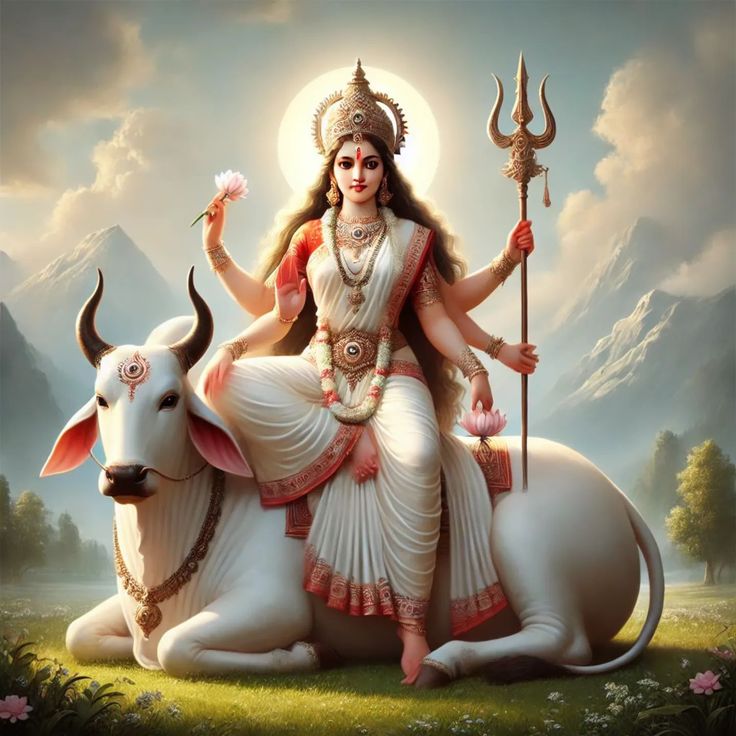
ॐ देवी शैलपुत्र्यै नमः॥🐚
वंदे वाञ्छितलाभाय चन्द्रार्धकृतशेखराम् ।
वृषारुढां शूलधरां शैलपुत्रीं यशस्विनीम्॥
The day has arrived 🪔 the sacred moment when we invite the Mother of the Universe into our homes, praying for her blessings of peace, prosperity, wealth, and protection. In India, Navratri isn’t just a festival. It’s a reminder that the world stands because of Shakti – the divine feminine energy that creates, nurtures and ultimately sustains all life. Without Shakti, even Shiva is lifeless.
During these nine days, families light diyas, clean their homes, set up ghatas (kalash), offer her garland, flowers, Chunari and begin fasts with utmost devotion. We bow down in front of Maa Durga, asking forgiveness for our mistakes, seeking strength to overcome negativity and consciously avoiding anything “Tamasic”(a quality of ignorance, darkness and inertia associated with laziness, dullness and negativity) – whether food, actions or thoughts that could offend her. For these nine days, we treat her as the supreme guest of our home, honoring her with rituals, flowers, mantras and fasting. 🌸🔥
But here lies the greatest irony of all. For nine days, we worship her as Shailputri, Brahmacharini, Chandraghanta, Kushmanda, Skandamata, Katyayani, Kaalratri, Mahagauri and Siddhidatri – each form a lesson in courage, sacrifice, purity, wisdom and strength. And yet, for the rest of the year women, the living embodiment of this divine feminine energy are disrespected, demeaned, objectified and reduced to a mere price tag.
We sing “Ya Devi Sarvabhuteshu, Shakti Rupena Samsthita Namastasyai, Namastasyai, Namastasyai, Namo Namah” 🙏, acknowledging her presence in every being. Yet we wound her reflection in our mothers, sisters, daughters and wives.
So I ask again: Do you think Maa Durga will truly be happy with this hypocrisy? Are we really living the values of what these Nav Durgas represent not just for nine days, but for all 365 days of the year?
Because when Durga Mata fought Mahishasur, Chand-Mund or Shumbh-Nishumbh, she didn’t just fight demons outside. She symbolically destroyed the demons within I,e, arrogance, ego, lust and injustice. Her war was a message: evil will always fall before truth and oppression will always be destroyed by the strength of the feminine divine ⚔️🔥
Yet, in today’s society, we’ve twisted this teaching. When women raise their voices against injustice, they’re told to “adjust.” When they face anger or violence, they’re told, “Men are supposed to be like this, women have to sustain.”
And the most painful part? These words aren’t just spoken by men. They often come from women themselves, women who have carried these wounds silently their entire lives, passing on the same burden to the next generation. 💔
Isn’t it shocking? The very Shakti we claim to worship is the same we suffocate with silence, excuses and endless compromises.
This is the question that burns in my heart every year as Navratri begins. 🌺 And while the world prepares to celebrate, I choose to reflect: What are we really celebrating? Rituals or responsibilities? Fasts or values? The goddess on the pedestal or the woman in our homes?
This is going to be quite a discussion. But before we dive deeper, let me take you into the journey of these 9 days – their history, their significance and what they truly mean for us in today’s world.
🌺 Day 1: Shailputri – The Daughter of the Mountains
Navratri begins with Maa Shailputri, the first form of Durga. Born as the Putri(daughter) of the mighty Himalaya (Shaila), she symbolizes purity, strength and the groundedness of Mother Earth itself.
Depicted riding a bull 🐂, holding a trident 🔱 in one hand and a lotus 🌸 in the other, Shailputri is also known as Parvati – the divine consort of Lord Shiva and the very embodiment of nature’s resilience.
In her previous birth, Maa Shailputri was born as Sati, the daughter of Daksha Prajapati and consort of Lord Shiva. When her father insulted Shiva during a yajna, Sati immolated herself in grief and anger. 🔥In her next birth, she took form as Parvati, daughter of the Himalayas, and reunited with Shiva. This cycle of rebirth reflects resilience, devotion and the power of a woman to rise from pain and humiliation with dignity. 🌸
Significance:
- Shailputri represents new beginnings 🌄. Just as Navratri starts with her, she is a reminder that every journey begins with patience and humility.
- She embodies root chakra (Muladhara) energy – the foundation of stability, strength and security in our lives.
- Worshipping her is believed to bring emotional balance, strength to face challenges and blessings of harmony in family life.
Rituals & Worship:
- Devotees offer fresh flowers 🌺, pure ghee 🪔 and milk to Maa Shailputri.
- The mantra “Om Devi Shailputryai Namah” is chanted to invoke her blessings.
- Fasting on this day is seen as a way to cleanse not just the body but also the mind.
But here’s the part that always strikes me. Maa Shailputri is revered as the daughter of the Himalayas, cherished and respected as a precious gift of the family. Yet how many daughters today are truly treated as blessings? How many are celebrated with the same honor we give Maa Shailputri on this day?
When I fold my hands before her idol, I cannot help but wonder: Are we respecting the “Shailputris” of our world? The girls born in our families, the women walking beside us, the sisters carrying unspoken battles – do we bow to them with the same humility we show here?
Navratri is not just about fasting, singing bhajans and doing rituals. At its core, it is a celebration of the divine feminine energy – the Shakti that drives creation, preservation and destruction. Each day we honor a different form of Maa Durga, symbolizing different strengths we need in life : courage, wisdom, patience, compassion and protection. But the essence is this: to respect, honor and protect women as living forms of the goddess.
Navratri tells us to celebrate Shakti but Shailputri reminds us that Shakti begins at home in the respect we give to the daughters of this world. 🌸
If we truly want to celebrate Navratri, let’s go beyond the rituals, respect women every day not just during festivals. Recognize their struggles during menstruation with empathy not shame. Protect their dignity at home first. Teach men that honoring Maa Durga starts with not only honoring their mothers, sisters and daughters 🌸 but others too.
Because last I checked, no goddess would be happy being placed on a pedestal for 9 days and ignored, insulted or violated for the rest of the year.
As we light the lamp and chant prayers to Maa Shailputri today, let’s also ignite the lamp of truth inside us. ✨
Navratri is not just about devotion, it’s about transformation. The divine feminine energy we celebrate is already living, breathing and suffering around us. Let’s not just worship the goddess. Let’s start respecting the woman.
Only then will Maa Durga’s blessings truly flow not just into our homes but into our hearts, our society and our future 🌏❤️
✨ That wraps up Day 1 of Navratri Pooja in India. Stay tuned as we continue this sacred journey through the remaining days. Until then Good Morning, Good Afternoon and Good Night to all. 🙏🌸”


 Story and Beyond with Pratiksha
Leave a comment