
I love movies – big or small, hit or flop. It doesn’t really matter. I like to watch them all not just for entertainment but to understand them. I want to see for myself why a film worked or why it didn’t. Because honestly, in today’s world or maybe it’s been this way for quite some time, people can make anything a hit. Sometimes the most mindless story becomes a blockbuster while the films that dare to say something deeper quietly disappear without the recognition they deserve.
Cinema for me has always been more than just a two-hour escape, it’s an emotion, a reflection of life and sometimes a mirror that shows you parts of yourself you didn’t know existed. I watch films not to judge them but to feel them, the way they capture silence, chaos, confusion and the unspoken corners of the human heart. Some movies fade away once the credits roll but a few stay with you long after the lights come back on. They linger like a thought you can’t shake, a line you can’t forget or a feeling you can’t quite name.
One such movie for me is Tamasha.
I remember watching it years ago, not expecting much. It wasn’t a “commercial hit” and many said it was too confusing or too emotional. But to me, it was real. It felt like someone had taken the noise inside my mind and turned it into a story. Every frame, every song, every silence – it spoke of something more profound than romance or drama. It spoke of us, of the masks we wear every day, the stories we tell to fit in and the quiet exhaustion of pretending to be someone we’re not.
There was something hauntingly human about Tamasha. It didn’t demand your applause, it demanded your honesty. It forced you to pause and ask yourself – am I really living my own story or just performing in someone else’s?
And that’s why Tamasha stayed with me not because it entertained me but because it understood me.
🎭 The Story Beyond the Story
Directed by Imtiaz Ali and starring Ranbir Kapoor and Deepika Padukone, Tamasha isn’t your typical love story. It’s not about two people finding each other, it’s about one person finding himself, piece by piece, through love, loss and awakening.
Imtiaz Ali known for his soulful storytelling doesn’t give us a fairy tale romance here. Instead, he gives us a mirror – one that reflects the conflict between who we are and who we are expected to be. And that’s where Tamasha hits differently.
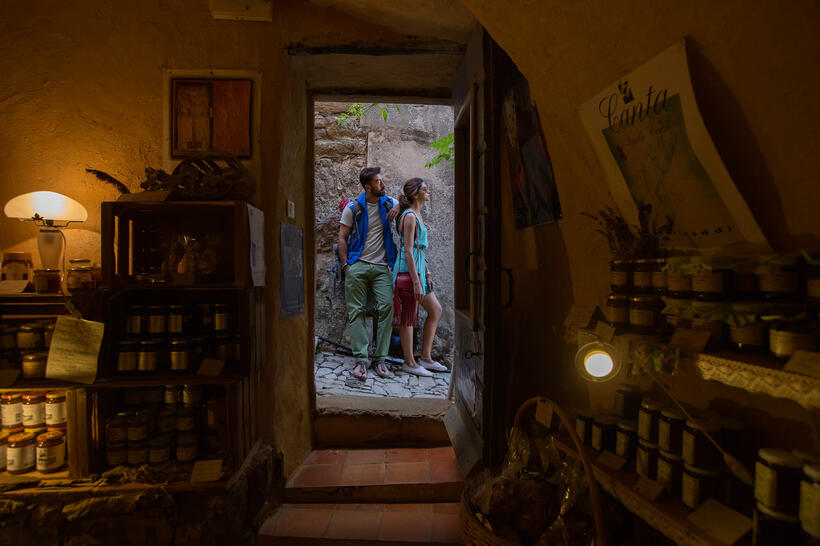
The film begins in the scenic, sunlit streets of Corsica where Ved (Ranbir Kapoor) and Tara (Deepika Padukone) meet by chance. Two strangers in a foreign land, a setup that could’ve easily turned into another predictable Bollywood love story. But instead, they choose something beautifully unexpected. They decide to keep their real identities hidden. No names, no pasts, no labels – just stories, laughter and freedom.
For a few days, they live like characters from a fairytale – dancing, teasing, inventing stories and soaking in the joy of being themselves without the world watching. There’s no pressure to impress, no need to be perfect, no mask to wear. Just pure, unfiltered human connection. That part of the movie feels like oxygen – light, spontaneous and alive. You can almost feel the freedom in their laughter, the spark in their eyes and that fleeting comfort of belonging to someone who doesn’t know your story but understands your soul.
But life isn’t Corsica. Reality doesn’t allow that kind of freedom for long.
When Tara meets Ved again years later in the bustling chaos of everyday life, she realizes something’s changed. The man she once met – wild, expressive and full of imagination now looks like everyone else around him. His eyes are tired, his smile rehearsed, his words cautious. The storyteller she fell in love with is gone replaced by a polite, well-dressed, robotic version of himself who clocks in, nods along and suppresses the spark that once made him Ved.
And that realization hits her and us like a quiet heartbreak. Because haven’t we all seen that transformation happen in someone we love? Or worse, within ourselves? The carefree, curious child slowly becomes an adult shaped by expectations, responsibilities and the fear of failure. We trade wonder for logic, creativity for control and authenticity for acceptance.
Ved’s story at its core is all of ours. We’ve all worn those masks, smiling when we’re tired, agreeing when we want to scream, pretending to be okay because that’s what’s expected. We’ve all hidden parts of ourselves to fit in, forgetting that the cost of fitting in is often losing what makes us different.
And that’s where Tamasha becomes so much more than just a movie, it becomes a mirror. A reminder of that version of us we once were before the world told us who to be.

🧠 The Battle Within: Who Are You Really?
This is where Tamasha truly hits you, not with loud drama, not with grand dialogues but with a quiet, piercing realization that stays long after the film ends. It’s not the kind of story that shouts its message; it whispers it gently but deeply straight to your heart.
Ved is not just a character, he’s every one of us. The person we’ve become after burying our inner spark beneath layers of expectations and fear. The child who once dreamt fearlessly, spoke without hesitation and lived with curiosity has now been replaced by an adult who follows a carefully written script that handed down by parents, teachers, bosses, society and even ourselves.
Imtiaz Ali doesn’t narrate Ved’s journey like a straight line from point A to B. Instead, he builds it like life : fragmented, unpredictable, layered with memory, metaphor and emotion. He takes us into Ved’s mind where imagination and reality constantly collide.
We see flashes of his childhood, a young boy sitting cross-legged in front of a roadside storyteller (played by Piyush Mishra) eyes wide, heart open, completely immersed in tales of heroes, villains and love. Those scenes feel almost magical, full of life, laughter and the wonder only children can feel. That boy doesn’t care about logic or timelines, he just feels the story. His world is vast, limitless and alive with possibility.
But as time passes, those stories once vivid and wild start fading into background noise. The storyteller’s voice becomes distant drowned out by the hum of deadlines, bills and responsibilities. The young dreamer grows up becomes “practical” and learns to silence that inner storyteller that once made him unique.
And isn’t that exactly what happens to most of us?
When we’re children, the world feels endless, everything is a story, every person a possibility. We build castles in the air, believe in magic and see life as an adventure waiting to unfold. But somewhere between school exams, job interviews and societal expectations, we start editing our own stories to fit the world’s version of “success”
We trade curiosity for caution. We stop asking “why” and start accepting “because that’s how it is”
We stop playing not just games but life itself.
We stop creating not because we can’t but because we’re too afraid to be seen as different.
And that’s what Tamasha captures so beautifully that heart breaking transition between being alive and merely functioning. The film doesn’t lecture you about it; it shows you in glimpses, in Ved’s forced smiles, his mechanical small talk and that flicker in his eyes every time his imagination tries to break free.
Imtiaz Ali holds up a mirror to our own lives and asks, when did you last listen to your inner storyteller? When did you last do something for no reason but joy? When did you stop being you?
That’s the quiet power of Tamasha. It doesn’t make you cry through tragedy, it makes you ache through recognition. You don’t just watch Ved lose himself, you realize in bits and pieces that maybe you did too.
💔 The Weight of Expectations
it’s not just Ved’s internal battle that breaks you, it’s the world around him that keeps tightening the cage, one expectation at a time.
Imtiaz Ali doesn’t paint society as the villain, he simply holds a mirror to how we all unknowingly become part of the system that crushes individuality. Ved’s parents, for instance, love him dearly. They want the best for him – stability, respect, success. But in the process, they push him toward a version of life they believe is “safe” His father’s constant reminders to focus on a “real job” or his mother’s quiet prayers for his well-being, they all come from love yet that love has conditions. It’s love wrapped in expectation and that’s what makes it so painfully real.
Our parents often dream through us hoping we’ll live the lives they couldn’t. Our friends expect us to always have it together, to be the one who’s “doing well”, Society expects us to follow the map: study, work, marry, settle. Even those closest to us – our partners, siblings, mentors project their hopes, fears and unfulfilled desires onto us often without realizing it.
In trying to meet those expectations, we start performing instead of living. We say “yes” when our heart screams “no”. We smile when all we want to do is break down. We attend social gatherings, nod through conversations, post pictures of happiness, all while feeling like strangers in our own skin.
That’s the quiet tragedy of modern life, the pressure isn’t loud or dramatic. It’s subtle. It’s in every “You should know what you’re doing by now”, every “Don’t waste your talent”, every “Look how well they’re doing”. It’s a slow, constant tightening – a rope made of approval and comparison that quietly strangles the storyteller within us.
Ved becomes the perfect metaphor for that suffocation. The man who once told stories with fire in his eyes now rehearses lines he doesn’t believe in “Yes, sir,” “Of course, sir,” “We’ll deliver it by Monday.” Every “sir” is another brick in the wall between who he is and who he’s supposed to be. His face moves, his body functions but his soul is locked away somewhere, whispering faintly: this isn’t who I am.
And that whisper, that faint, trembling voice is something we all recognize. It’s the part of us that still remembers what it felt like to be free, to be curious, to be alive. The part that still believes we’re meant for more than routines and responsibilities.
That’s the genius of Tamasha. It doesn’t scream rebellion; it quietly exposes the suffocation of conformity. It reminds us that sometimes the biggest prisons are the ones built with love and good intentions and the hardest freedom to claim is the right to be yourself.
🌈 When Love Becomes a Mirror
Tara’s role in Ved’s journey is both beautiful and heartbreaking. She isn’t written as the typical “savior” figure who walks into a man’s life and changes everything. Instead, she’s the mirror who reflects Ved’s truth back to him when he’s forgotten what it looks like.
Tara falls in love with Ved’s essence : the spontaneous storyteller, the free soul who once danced through Corsica with laughter in his eyes and magic in his words. That version of him was real, alive, untamed. But when she meets him again in the structured chaos of his corporate life, what she finds is not the man she loved but a shell – someone rehearsed, polite and painfully disconnected from his own fire.
And that’s where her love becomes both her strength and her sorrow. She loves him deeply but she can’t reach the version of him he’s buried under layers of expectations. Her presence doesn’t fix him, it awakens him.
Sometimes love doesn’t heal you instantly. It shakes you awake. It stirs something raw inside you, something you’ve long silenced. Tara does exactly that. She holds up a mirror so sharp and honest that Ved can no longer avoid what he sees the truth of his own pretending. He realizes that somewhere along the way, the storyteller became the story everyone else wanted to hear.
It’s not easy to love someone and still let them face their chaos. But Tara does that she steps back when she needs to even when it hurts. Because she knows this is Ved’s battle to fight. Her role isn’t to rescue him from the storm but to remind him he was never meant to live in one.
That’s what makes Tara’s love rare. It’s not possessive or dramatic – it’s grounding, reflective and deeply human. She doesn’t ask Ved to change for her; she silently asks him to remember himself. And that’s perhaps the most powerful kind of love that doesn’t complete you but helps you find the courage to be complete on your own.
💥 The Breakdown and the Breakthrough
Ved’s breakdown scene that gut-wrenching moment when he finally screams, “Main theek nahi hoon!” is the emotional heart of Tamasha. It’s not just a cinematic outburst; it’s years of silent pain, confusion and suppressed individuality exploding all at once. It’s the point where the mask shatters.
For so long, Ved has lived by the rules doing everything “right,” saying everything that’s expected. But when he finally breaks down, it’s the human in him refusing to stay silent any longer. The facade collapses and beneath it we see a child who once believed in magic, now lost in a world of deadlines and expectations.
His confrontation with his father is one of the rawest, most vulnerable moments in Indian cinema. There’s no melodrama, no villain – just two generations trying and failing to understand each other. The father represents love bound by fear – fear of failure, fear of instability, fear of being different. Ved, on the other hand represents the soul suffocating under that fear, yearning to breathe freely again. It’s heart breaking because it’s real.
We’ve all been there sitting across from people we love trying to explain a pain we can’t articulate. Trying to say, “I’m not ungrateful, I’m just lost.” Trying to make them understand that the life we’re living isn’t really ours, that we’ve become strangers in our own stories.
Ved’s journey back to the storyteller, back to the origin of his imagination is more than a narrative closure, it’s a return to authenticity. When he revisits that roadside storyteller from his childhood, it’s as if he’s meeting the version of himself he left behind. That moment isn’t about nostalgia; it’s about healing.
Because breaking down isn’t weakness, it’s rebirth. It’s the moment the noise quiets and the truth finds its voice. For Ved, that breakdown isn’t the end of his story, it’s the beginning of his becoming. It’s him saying for the first time, “I want to live my story, not the one written for me”
And maybe that’s the greatest message Tamasha gives us that the only way to truly live is to stop performing and start being. To reclaim the storyteller inside us, the one who still believes that life can be beautiful when it’s lived on our own terms.
🎬 Visual Poetry and Music That Speaks
The visual language of Tamasha is just as poetic and layered as its story, every frame feels like it’s speaking its own emotional truth. Imtiaz Ali and cinematographer Ravi Varman don’t just capture moments; they paint them. The film’s shifting palette mirrors Ved’s inner world – bright and uninhibited in Corsica, muted and restrained in his “real” life.
Corsica bursts with colors : golden light, deep blues, warm reds, a visual celebration of freedom. It’s a place untouched by responsibility where Ved and Tara exist beyond definitions. The wide landscapes, the spontaneity, the chaos – it all mirrors the joy of being unmasked, of living without boundaries. You can feel the breeze, the laughter, the reckless abandon in every frame.
Then when the story shifts back to Ved’s everyday life in Delhi, the tone changes drastically. The colors drain out, the greys, beiges and blues of his corporate world replace the warmth of Corsica. His neatly pressed shirts, sterile office lights and structured routines visually cage him. Even his home feels more like a shell than a space of comfort. This visual contrast is deliberate, it’s the cinematic translation of what happens when freedom gives way to conformity.
Imtiaz doesn’t need to tell us Ved is trapped; he shows it. The repetition of office scenes, the robotic commute, the mechanical smiles everything silently screams monotony. The camera lingers just long enough to make us feel his emptiness. And yet, when Ved starts rediscovering himself later, color slowly returns, the visual world breathes again, just as he does.
And then, there’s A.R. Rahman’s music, the emotional undercurrent that gives Tamasha its heartbeat. His compositions don’t just accompany the story; they amplify it.
“Agar Tum Saath Ho” is pure ache that holds all the unsaid words between Ved and Tara. It’s not just about heartbreak; it’s about two people standing at the crossroads of love and selfhood. Alka Yagnik’s voice carries the kind of tenderness that feels almost human that makes your chest heavy because you know that feeling too. You can sense Tara’s helplessness, her love, her pain as she watches Ved slip away into a version of himself she doesn’t recognize.
And then “Tu Koi Aur Hai” a haunting masterpiece that plays during Ved’s awakening. It’s not a song; it’s a prayer. The lyrics hit you like truth reminding you that somewhere beneath all the layers of who we’ve become, there’s someone we used to be. That realization paired with Rahman’s melody is almost spiritual. It’s as if the music itself becomes Ved’s companion on his journey back to himself.
Every note in Rahman’s soundtrack feels intentional like a heartbeat syncing with Ved’s emotions. The rhythm of Corsica is playful and wild while the rhythm of his daily life is slow and suffocating. But as the film progresses, the music bridges those worlds guiding him from chaos to clarity, from imitation to authenticity.
That’s the beauty of Tamasha. It’s not just something you watch; it’s something you feel in the colors, in the silences, in the songs that linger long after the credits roll. It reminds you that cinema at its best doesn’t just tell stories, it mirrors our own.
🌻 The Human Truth: We All Wear Masks
What Tamasha ultimately tells us is profoundly simple yet incredibly difficult to live: we’re all performers in the grand drama of life. From childhood, we learn the roles expected of us : the obedient student, the dutiful child, the ambitious professional, the reliable friend, the supportive partner. We learn to smile when we’re tired, to agree when we want to rebel, to hide our tears behind polite words. Life becomes a stage and we become actors performing scripts written by others.
But there’s a vital difference between acting for the world and truly living for yourself. One is survival, the other is living. Acting for the world may keep you safe, socially acceptable and even successful on paper but it comes at a cost: your dreams, your passions, your voice – the very essence of who you are.
Tamasha doesn’t ask you to reject responsibility and it doesn’t preach rebellion for rebellion’s sake. It reminds us that it’s okay to live with obligations and care for others but not at the expense of losing your soul. Ved’s journey is a testament to this truth. He carries the weight of expectations, the invisible chains of judgment and conformity until the pressure almost destroys him. Yet, it’s in reclaiming his story : his creativity, his imagination and his vulnerability that he finds freedom.
The world may never fully understand your choices and that’s perfectly okay. People may question your path, doubt your decisions or try to push you back into a mold that doesn’t fit. But authenticity isn’t about pleasing others; it’s about honoring yourself. You don’t need everyone’s approval to be true to who you are.
The moment you start living your truth, something miraculous happens. The mask that once felt like a lifeline becomes a cage and when it falls, the air feels different. You can breathe again. You laugh more freely, speak more honestly and notice the colors in your world that had long been muted. Your steps are lighter because you’re no longer carrying the invisible weight of everyone else’s expectations.
Tamasha reminds us that life isn’t about perfection, conformity or approval. It’s about rediscovering the storyteller inside us who believed in magic, loved deeply and dared to imagine a life worth living. And perhaps the most humane, enduring message of the film is this: no matter how long you’ve hidden, it’s never too late to take off the mask and finally be yourself.
It’s in that moment of truth – raw, unguarded and real that life begins again.

For me, Tamasha isn’t just a movie, it’s a mirror held up to our generation reflecting the quiet struggles we all carry but rarely acknowledge. It speaks directly to the dreamers trapped in cubicles who trade their passions for pay checks; to the artists buried under endless deadlines compromising creativity for conformity and to the countless souls who day after day put on a brave face and pretend they’re okay even when their hearts are quietly screaming for authenticity.
What makes the film so profoundly relatable is its honesty. Ved’s story isn’t unique, it’s universal. Every one of us has at some point silenced our curiosity, hidden our quirks and conformed to expectations that were never truly ours. We have nodded when we wanted to scream, smiled when we wanted to cry and followed paths that felt like prisons, all to fit into a world that rewards compliance over courage.
Tamasha reminds us gently but insistently that it doesn’t have to be this way. You don’t have to live the life others scripted for you. You’re allowed – no, you’re encouraged to break free from the cages of expectation. You’re allowed to disappoint others, to question the path laid out for you and to follow the voice that feels like home that quiet inner compass that knows who you are at your core.
Life is indeed a Tamasha : a show, a performance, a stage with its joys and sorrows, its applause and silences. But the greatest act you’ll ever perform is not the one that earns accolades or fits the mold. The greatest act is living unapologetically, embracing your true self with all its flaws, fears and brilliance.
Tamasha doesn’t just entertain, it wakes you up. It whispers that the person you’ve been hiding, the dreamer, the storyteller, the child who once believed in magic that person is still inside you waiting to be rediscovered. And when you finally take off the mask even for a moment, the stage transforms. The air feels lighter. The world feels wider. And for the first time in a long time, you can breathe fully, freely and truly as yourself.
Because in the end, no performance, no approval, no expectation compares to the triumph of being wholly, authentically and unapologetically you 🎭


 Story and Beyond with Pratiksha
Leave a comment