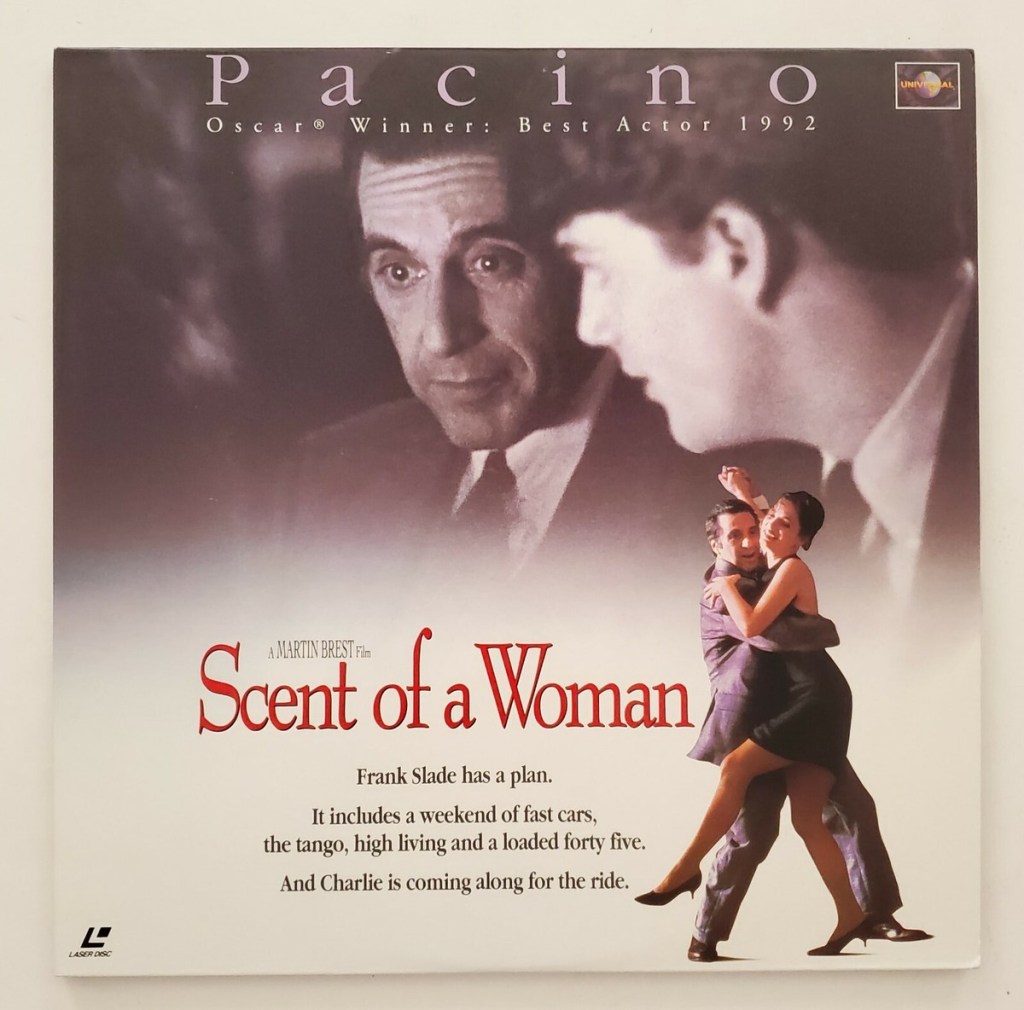
I have always been drawn to the classics films that don’t just tell a story but become one. They’re not loud, they don’t rely on spectacle or technology to move you. Instead, they breathe. They linger in your mind like an old melody, resurfacing at unexpected moments to remind you of something true, something human. Scent of a Woman is one such masterpiece. It didn’t just entertain me, it transformed me.
This is a film that speaks in silences in the quiet between words, in the subtle tremor of emotion that passes across a face, in the way two completely different souls begin to understand each other. It’s cinema at its most honest where truth isn’t declared, it’s felt.
Directed by Martin Brest and elevated by Al Pacino’s once-in-a-lifetime performance, Scent of a Woman isn’t just a story about a blind man and a boy. It’s about the unseen grace that kindness brings into our lives. It’s about how goodness that doesn’t shout or demand recognition has a power far greater than we realize.
This movie reminded me of something we often forget in the rush of modern life: kindness isn’t weakness. It’s strength wrapped in humility. It’s courage without noise. It’s the quiet decision to do what’s right even when no one’s watching.
Because the universe has its own rhythm that rewards empathy, integrity and compassion in ways that are often invisible but always certain. Scent of a Woman believes in that rhythm. It believes that even when life blinds us through disappointment, loss or despair, the heart can still see.
And that’s why this film stays with you. It’s not just about the bond between a disillusioned colonel and a young student; it’s about the bond between your own conscience and your choices. About how decency no matter how small creates ripples that reach farther than we ever imagine.
🎬The Art of Direction and Performance(When Cinema Breathes Humanity)
Directed by Martin Brest, Scent of a Woman stands as a masterclass in storytelling where craft and emotion intertwine so seamlessly that it feels less like a movie and more like life unfolding on screen. The film is elevated to greatness by one of cinema’s most unforgettable performances – Al Pacino as Lieutenant Colonel Frank Slade. His portrayal is not just acting, it’s an immersion, a surrender. Pacino embodies Slade with raw vulnerability rarely seen : volcanic in anger, piercing in honesty and achingly tender beneath the armor of arrogance. Every word he speaks carries weight, every silence feels earned. It’s no wonder this role earned him his long-overdue Academy Award, it wasn’t just recognition of a performance but of a lifetime of mastering the human condition.
The film’s cinematography under the eye of Donald E. Thorin mirrors Slade’s inner world like poetry captured in light. The visual language of the movie moves like a dance – deliberate, expressive and deeply symbolic. The dim, shadow-filled interiors of Slade’s home echo his blindness and isolation, a man imprisoned not by walls but by his own despair. Then comes the golden warmth of the New York hotel suites where indulgence meets fleeting freedom and finally the play of chiaroscuro – light and shadow blending, clashing representing Slade’s moral and emotional turbulence. Every frame feels alive charged with unspoken emotion. It’s not just what you see but what you feel between the shots – the spaces where truth hides.
At first glance, the story seems simple: Charlie Simms (Chris O’Donnell) a modest scholarship student at an elite prep school takes up a temporary Thanksgiving job to care for a retired, blind and temperamental army officer. But beneath that simplicity lies a profound narrative of redemption, integrity and human connection.
Charlie is everything the world often overlooks – quiet, decent and good-hearted. Surrounded by privilege and corruption, he clings to his integrity as if it’s the only thing that truly belongs to him. He’s uncertain about his future yet unwavering in his sense of right and wrong. In him, we see the moral compass of youth : fragile but true.
And then there’s Colonel Frank Slade, once a man of discipline and power, now consumed by bitterness and self-loathing. His blindness is more than physical; it’s existential. He’s seen too much of the world’s hypocrisy, too little of its grace. He masks his pain with arrogance, his loneliness with anger and his despair with dark humor. But beneath the gruff exterior lies a man desperate to feel alive again, even if for one last weekend.
When these two worlds collide, Charlie’s idealism and Slade’s cynicism something extraordinary happens. Their relationship begins as transactional but slowly, almost imperceptibly transforms into something sacred. They push each other, challenge each other, break each other open. Charlie becomes the mirror Slade needs, someone who sees beyond his blindness who treats him not with pity but with respect. And in return, Slade becomes Charlie’s unlikely teacher, teaching him that living with courage and conviction is far more important than simply surviving with comfort.
Under Martin Brest’s sensitive direction, this dynamic never feels forced or sentimental. It breathes with authenticity. The silences between them, the frustration, the laughter, the quiet realizations – they all build toward a truth that transcends the screen. What begins as a caretaker’s job becomes a soul-deep connection – two lost souls rescuing each other from different forms of blindness.
Charlie helps Slade see life again not through sight but through sensation, through the rhythm of experience. And Slade teaches Charlie to live – fiercely, truthfully and unapologetically reminding us all that the measure of a life isn’t in its ease but in its courage.
⚖️ The Beauty of Contrast(Where Innocence Meets Experience)
And that’s where Scent of a Woman truly transcends the screen, in its contrasts. The film thrives on duality: youth and age, hope and despair, light and shadow, sight and blindness. Charlie’s innocence collides with Slade’s cynicism that doesn’t destroy either but instead forges something luminous in between.
Charlie is the embodiment of conscience, a young man caught at a moral crossroads, surrounded by temptation, manipulation and the quiet corruption of privilege. He’s seen his peers cheat, lie and betray for self-preservation yet something in him refuses to bend. His decency isn’t dramatic or loud : it’s quiet, steadfast and real. It’s the kind of integrity that often goes unnoticed but changes everything.
Slade, on the other hand is a man who’s lived long enough to lose faith in people, in justice, in himself. His bitterness is a shield, his arrogance a mask. Yet beneath the layers of anger and pride lies a flicker, a longing for redemption he can’t admit. He’s a man who believes his story is over until Charlie’s presence reminds him that life still has music left to play.
Their connection unfolds like a dance, cautious at first then rhythmically in sync. Charlie’s empathy begins to chip away at Slade’s defenses and in turn, Slade’s raw honesty challenges Charlie to step into his own power. Each scene between them becomes a tug of war between despair and hope until one begins to mirror the other.
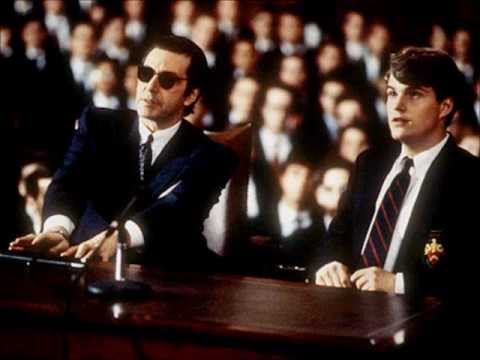
And then comes the film’s most defining moment – the courtroom scene. It’s not just the emotional climax; it’s the film’s soul laid bare. When Colonel Slade stands up to defend Charlie, it’s not just a man speaking – it’s truth itself finding its voice. Pacino’s monologue here is electric delivered with a conviction that commands silence.
“There is nothing like the sight of an amputated spirit; there is no prosthetic for that.”
That line lands like thunder because it speaks to something primal in all of us, the quiet wars we fight between convenience and conscience. Slade’s defense of Charlie is more than a gesture; it’s a resurrection. It’s a moment where a man who had given up on life finally chooses to stand for something, not for himself but for the light he sees in another.
In that courtroom, you realize the story isn’t just about a student or a soldier. It’s about all of us, anyone who’s ever stood at the edge of compromise and chosen integrity instead. Slade’s words don’t just vindicate Charlie; they redeem himself. It’s his way of saying: I may have lost my sight, but I can still see what matters.
That moment, that raw, thunderous declaration of character is cinema at its purest. It’s not special effects, not spectacle but truth, stripped bare that makes you sit a little straighter, breathe a little deeper and ask yourself what you stand for when no one’s watching.
💃 The Tango Scene: When Fear Fades and Freedom Takes the Lead
If there’s one moment that defines Scent of a Woman that elevates it from a brilliant film to a timeless piece of art, it’s the tango scene.
A blind man dancing with absolute grace, confidence and charm – it’s cinematic magic but it’s also philosophy in motion.
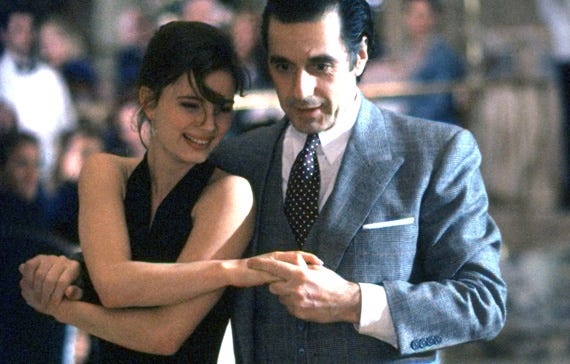
When Colonel Frank Slade takes Donna’s hand and leads her to the dance floor, we don’t just see a man dancing – we witness a soul reclaiming its rhythm. Despite his blindness, Slade moves with fluidity and assurance as if guided not by sight but by instinct, by trust, by the music pulsing through his veins. It’s a lesson in living that sometimes you don’t need to see the path ahead to move beautifully through it.
“No mistakes in the tango, Donna. Not like life. It’s simple. That’s what makes the tango so great.”
In that moment, he isn’t blind anymore. He’s alive.
That scene isn’t just about the dance; it’s about liberation. It’s where fear quietly slips away and freedom steps in to take its place. For a moment, you can feel the shift in Slade’s body, in his spirit – the weight of bitterness dissolving replaced by pure presence. The world which had long been a battlefield for him suddenly becomes a ballroom.
And Donna, his dance partner represents something more than a fleeting moment of connection. She is grace personified that allows someone wounded to feel safe again. Their chemistry isn’t romantic, it’s soulful. It’s about two people meeting in rhythm, in trust, in freedom.
As the violin swells and they move across the floor something extraordinary happens, you can almost see the invisible transformation. The lines on Slade’s face soften. His shoulders ease. The anger that once consumed him melts into a quiet smile. In that fleeting moment fear loses its grip and freedom touches his soul.
That dance becomes a metaphor for life itself – unpredictable, imperfect but breathtaking if you dare to surrender to its music. It reminds us that control is an illusion and sometimes the only way to truly live is to let go.
The tango scene stays with you long after it ends not because it’s grand or showy but because it feels like truth. It tells us that no matter how broken, blinded or bruised we are, life still offers us chances to dance, to feel joy, to move with courage, to let beauty find us again.
In that moment, Scent of a Woman stops being a film and becomes something more – a meditation on being alive.
🌅The Humanity of It All: How Broken Souls Find Redemption
What makes Scent of a Woman truly timeless isn’t its grandeur, it’s its humanity. This isn’t a story about perfection or victory; it’s about brokenness, vulnerability and the quiet courage it takes to begin again. It’s about people who’ve fallen yet still have the grace to rise not because they’re fearless but because someone reminds them that they can.
Colonel Frank Slade with all his arrogance and anger isn’t the hero we’re taught to admire. He’s flawed, wounded and achingly human. His blindness is both literal and symbolic – a reflection of how life’s disappointments can cloud our vision and extinguish our will to live. But the brilliance of Al Pacino’s performance lies in how he lets us see the man behind the bitterness. You catch it in fleeting moments, the tremor in his voice when he speaks of regret, the longing in his silences, the flicker of vulnerability behind his bravado.
Opposite him stands Charlie Simms – young, idealistic and morally steadfast. Chris O’Donnell’s portrayal might seem understated but that’s precisely what makes it powerful. He’s the quiet force that grounds the chaos around him. His kindness is unassuming, his empathy effortless that doesn’t seek applause but still changes lives.
Their relationship, the reluctant friendship between a lost boy and a broken man becomes the heart of the film. It’s not built on sentimentality; it’s built on truth. Charlie doesn’t try to fix Slade. He simply sees him not as a burden, not as a project but as a person. And sometimes being seen with that kind of honesty is the first step toward healing.
Under Martin Brest’s masterful direction, every frame breathes with meaning. The cinematography by Donald E. Thorin captures this duality beautifully – the interplay of light and shadow mirroring the inner worlds of both men. Slade’s home cloaked in dimness feels suffocating, a reflection of a life turned inward. But as the story progresses, as the two step into the golden warmth of New York City, the lighting subtly changes symbolizing a rekindling of hope, a return to life.
Then comes the courtroom scene – the soul of the movie. When Slade defends Charlie, his words cut deeper than any sermon could.
“There is nothing like the sight of an amputated spirit; there is no prosthetic for that”. It’s not just dialogue, it’s revelation. It’s the moment when a man who had given up on life becomes its fiercest defender.
That speech isn’t about saving Charlie; it’s about saving himself. In standing up for integrity Slade finds redemption not through forgiveness or apology but through courage. He finds his way back to the man he once was, the man who believed in honor, in truth, in goodness and through him, we’re reminded that it’s never too late to turn back toward the light.
Scent of a Woman shows us that redemption doesn’t come from grand gestures or perfect endings. It comes from connection, from kindness, from choosing to do what’s right even when it costs you something. It’s about finding grace in imperfection, beauty in brokenness, and humanity in the simplest of acts.
Because sometimes, saving someone else is how you save yourself.
🎥 Where to Watch ‘Scent of a Woman’ Today
If you haven’t yet experienced Scent of a Woman, you can stream it today on platforms like Netflix, Amazon Prime Video, Apple TV, YouTube Movies and Google Play Movies.
It’s a film that deserves to be watched in silence, no distractions, no multitasking – just you, the screen and the raw brilliance of Al Pacino filling every frame.
Rewatch it if you’ve seen it before. You’ll find that every time you do, the film feels different, deeper as if it grows with you. Because that’s what true cinema does; it doesn’t just entertain, it evolves alongside your own journey.
In the end, Scent of a Woman is more than cinema, it’s a meditation on what it means to live, to fall, to rise and to redeem.
It teaches that life isn’t about achievements or titles; it’s about choices especially the ones we make when no one’s watching.
Sometimes, the smallest act of kindness can change the course of someone’s life including your own.
So live boldly. Love deeply.
And dance even when you can’t see the floor.
Because the rhythm of life never stops.
It’s just waiting for you to join in.


 Story and Beyond with Pratiksha
Leave a comment