Do you know what’s the timeless beauty of classics, they don’t just entertain; they endure. They linger in your mind quietly questioning societal structures, human priorities and the delicate balance between ambition and sacrifice. They force you to confront uncomfortable truths about who we are and what we value. And that’s precisely why they were made not merely to be watched but to stay with you, to shape thought, evoke empathy and spark change.
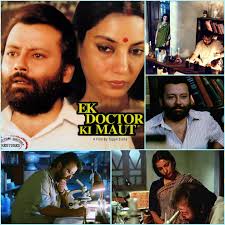
Ek Doctor Ki Maut (1990) directed by Tapan Sinha is one such rare creation that transcends time and trends. On the surface it is a story of scientific discovery, a doctor’s relentless pursuit of a medical breakthrough. But beneath that, it is a haunting exploration of obsession, neglect and the crushing indifference of society toward its own visionaries. It reveals the price of brilliance in a world that often fears what it cannot immediately understand.
Yet what truly makes the film exceptional is its progressive soul. At a time when mainstream Indian cinema frequently confined women to the margins as romantic interests, muses or silent spectators but Sinha’s film gave them presence, dignity and purpose. The women in Ek Doctor Ki Maut are not ornamental; they are integral to the emotional and ethical fabric of the story. They embody empathy, resilience and moral clarity standing not behind the men but beside them often stronger in silence than those who speak loudest.
In its quiet way, the film reminds us that progress whether scientific or social often begins with isolation but it finds its meaning in compassion. It’s not just a film about discovery; it’s about humanity.
A Man Consumed by His Work
The film unfolds through the journey of Dr. Dipankar Roy (played brilliantly by Pankaj Kapur), a government doctor consumed by his unrelenting pursuit to find a cure for leprosy. His work isn’t just a profession, it’s an obsession an all-consuming calling that isolates him from the very world he’s trying to heal. Sinha captures this obsession not in grand dialogues but in the quiet, persistent rhythm of Dipankar’s life – the dimly lit lab, the rustle of papers, the clinking of test tubes and the haunting stillness of nights where the only companion is the echo of his own thoughts. His dedication borders on self-destruction, his brilliance shadowed by the immense personal cost of isolation and neglect.
Seema Roy (portrayed with remarkable restraint and grace by Shabana Azmi) is far from a secondary character in this narrative. She is not just “the wife of a genius”; she is a woman of depth, dignity and silent endurance. Living alongside a man so devoted to his cause that he forgets how to live, Seema becomes the emotional mirror of the story reflecting the human cost of obsession. She supports him steadfastly, her love unwavering even as loneliness quietly erodes her spirit. Her heartbreak isn’t loud or dramatic; it’s subtle that sits heavy in the silences between words.
In one of the film’s most telling moments, she softly says, “Aap apne kaam ke alawa kuch dekhte hi nahi” a simple line that carries the ache of countless unspoken evenings, unfinished conversations and invisible sacrifices. It’s a sentence that holds both love and resignation, the pain of loving someone who has no space left to love you back.
This is where Tapan Sinha’s genius lies. He doesn’t relegate Seema to the sidelines nor does he make her a symbol of pity. Instead, he gives her narrative weight – her emotions, her silences, her quiet strength are as integral to the film as Dipankar’s scientific quest. She is the heartbeat of the story grounding the film in humanity when intellect threatens to overtake emotion.
At a time when mainstream Indian cinema often painted women as ornaments of the plot, romantic ideals or moral foils, Sinha created Seema as a woman of agency and awareness. Her life may revolve around her husband but her existence is never defined solely by him. She questions, endures and loves in her own right embodying both fragility and fortitude.
In many ways, Seema Roy represents the countless unsung partners of dreamers and revolutionaries who hold the emotional fabric of brilliance together often unnoticed. Her quiet strength doesn’t oppose Dipankar’s ambition; it completes it. She is not behind him or beneath him, she walks beside him invisible to the world but indispensable to his journey.
Work-Life Balance and Its Emotional Cost
The film in many ways ahead of its time becomes a mirror to the consequences of an unbalanced life where ambition overshadows affection and purpose replaces presence. Dr. Dipankar Roy’s unwavering pursuit of his research noble in intent but obsessive in execution slowly erodes the delicate fabric of his home. His devotion to science is absolute yet it’s a devotion that extracts a quiet but devastating toll. Long before phrases like “work-life balance” entered our vocabulary, Tapan Sinha’s film laid bare this universal truth: when passion turns into fixation, it doesn’t just consume the dreamer; it consumes everyone orbiting around that dream.
Through Seema’s character, this imbalance is rendered with heartbreaking realism. She isn’t angry or rebellious, she is resigned and that resignation speaks louder than confrontation ever could. In her silences, we sense the emotional fatigue of countless nights spent waiting for a husband who is physically present but emotionally absent. Her loneliness doesn’t scream; it lingers in the pauses between their interactions, in the small moments where love feels like duty and companionship turns into coexistence.
Seema becomes the voice of those countless partners especially women who carry the emotional weight of ambition that isn’t their own. They hold homes together while slowly coming undone within them. Her sacrifices are invisible, her contributions unacknowledged yet her steadiness forms the moral and emotional backbone of the story.
Sinha, with remarkable sensitivity reminds us that the cost of greatness is rarely singular. Every act of brilliance leaves behind a shadow that often falls on those who love the dreamer most. The pursuit of purpose when untempered by empathy can isolate not only the individual but also the relationships that give life meaning.
In this sense, Ek Doctor Ki Maut isn’t just a film about scientific discovery – it’s a quiet, haunting meditation on the human cost of obsession on how the pursuit of immortality through work can sometimes make us forget the life that’s happening right beside us.
The System vs. the Individual
After years of relentless almost monastic dedication, Dr. Dipankar Roy achieves what few dare to dream – a potential cure for leprosy, a discovery that could change the course of public health and human dignity. But instead of the applause his work deserves, he is met with indifference, suspicion and bureaucratic suffocation. The very system meant to encourage innovation turns hostile. Committees nitpick his methods, colleagues quietly envy his success and the establishment threatened by his brilliance seeks to undermine rather than uplift. His lab becomes not a place of celebration but a battleground of politics and ego.
What should have been a national triumph becomes a national embarrassment not because of failure but because of how small minds respond to great minds. Sinha masterfully exposes this hypocrisy: a society that glorifies mediocrity while crucifying excellence that rewards obedience over originality. Through Dr. Roy’s humiliation, we see a broader truth that progress in India often comes not through support but in spite of the system.
Yet beyond the intellectual and institutional injustice lies a more intimate tragedy : the quiet erosion of a life. While Dr. Roy’s name is questioned in official circles, his marriage crumbles in private. His success isolates him not only professionally but personally. Seema, once his companion and emotional anchor becomes an observer of his decline watching the man she loves slip deeper into bitterness and obsession. Her own identity dissolves under the weight of his disillusionment; she becomes both caretaker and casualty of his passion.
Sinha delicately intertwines the public betrayal of genius with the private loneliness of love. The film doesn’t romanticize suffering, it confronts it. It shows how a man’s pursuit of greatness when met with institutional cruelty can unravel the very fabric of his humanity. And how in that unraveling, the people closest to him silently bear the cost : unseen, unthanked but deeply scarred.
In the end, Ek Doctor Ki Maut becomes not just a critique of bureaucratic rot but a profound reflection on the emotional price of brilliance, how every discovery comes with a shadow and how behind every genius stands someone who quietly endures the fallout of his light.
A Progressive Portrayal of Women
One of the most remarkable and quietly revolutionary aspects of Ek Doctor Ki Maut lies in its portrayal of Seema Roy played with exquisite restraint and emotional depth by Shabana Azmi. At a time when Indian cinema largely confined women to ornamental or peripheral roles – the dutiful wife, the suffering lover, the moral compass or the sacrificial mother – Tapan Sinha crafted Seema as a woman of agency, intellect and quiet strength. She is not just the doctor’s wife; she is the film’s conscience, the pulse that humanizes its intellectual and emotional landscape.
Azmi’s Seema is written and performed with rare sensitivity. She embodies the dignity of a woman whose love is steadfast but not submissive, whose silence carries the weight of understanding, not surrender. Her pain isn’t melodramatic : it’s lived, layered and profoundly real. In her restrained gestures and unspoken thoughts, Azmi captures the ache of loving someone consumed by ambition, a love that asks for nothing yet quietly bears everything. And yet, Seema is never portrayed as a victim. She is grounded, perceptive and emotionally self-aware making her presence as vital to the story as Dr. Roy’s discovery itself.
What makes this portrayal extraordinary is its refusal to objectify or diminish her. The camera doesn’t treat her as background beauty or moral support, it listens to her. It gives weight to her silence, space to her thoughts and meaning to her emotional labor. When she reminds Dr. Roy, “Aap apne kaam ke alawa kuch dekhte hi nahi,” it’s not an accusation, it’s the truth of countless women whose lives orbit around someone else’s purpose. Yet Tapan Sinha with rare empathy allows her to exist beyond that orbit. She is not the shadow behind his brilliance, she is the light that keeps it from fading into darkness.
In the broader context of Indian cinema, this was a radical shift. The early ’90s were still steeped in patriarchal storytelling where women’s roles were written as embellishments not equals. But Ek Doctor Ki Maut quietly broke that tradition. Through Seema, Sinha asserted that a woman’s story, her emotional journey, her inner resilience could stand parallel to a man’s intellectual pursuit not beneath it. And in doing so, he opened a small but powerful door for the kind of cinema that would come years later, films that dared to explore women as complex individuals with agency, flaws and desires of their own.
This portrayal also resonates with Shabana Azmi’s broader artistic and ideological legacy. Across her body of work from Arth and Ankahi to Paar and Fire, Azmi has consistently chosen roles that challenge patriarchal narratives and redefine the emotional intelligence of Indian women on screen. Her characters don’t just endure; they evolve. Seema too carries that same undercurrent of quiet rebellion : a woman who refuses invisibility, who holds her dignity even when the world doesn’t see her.
In many ways, Ek Doctor Ki Maut became part of a continuum, a cinematic lineage that paved the way for stories like English Vinglish, Thappad and The Great Indian Kitchen. Films where women no longer whisper their truths but speak them unapologetically. Where solitude isn’t punishment but power. Where the female gaze shifts from endurance to self-realization. Seema walked so that these women could run, each one rewriting what it means to be seen, to be heard and to be whole.
In giving Seema her due space and soul, Tapan Sinha with Azmi as his perfect collaborator did more than tell a story about scientific discovery. He captured something far rarer: the emotional cost of brilliance, the quiet resilience of love and the enduring truth that equality on screen begins with equality in storytelling.
Performances That Resonate
Pankaj Kapur’s portrayal of Dr. Dipankar Roy is nothing short of haunting. He doesn’t play the part of a conventional cinematic genius; he becomes the man whose life has been reduced to a singular obsession. His eyes carry the exhaustion of endless nights in a dimly lit lab, his posture reflects the weight of unacknowledged brilliance and his silences speak louder than words. Kapur embodies the paradox of genius, a man capable of extraordinary vision yet painfully blind to the emotional world collapsing around him. His Dr. Roy is not arrogant but achingly human torn between his love for science and his inability to balance it with the simple, tender rhythms of everyday life.
Shabana Azmi’s Seema, on the other hand is the quiet storm to his chaos. Her performance is built not on grand gestures but on restraint that allows the audience to feel her ache without her ever articulating it. Through the smallest expressions, a lingering glance, a soft sigh, a patient smile that masks disappointment Azmi conveys the life of a woman both deeply in love and deeply alone. She captures the pain of invisibility, the resilience of devotion and the grace of someone who keeps loving even when love feels one-sided.
Together, Kapur and Azmi create a relationship that feels profoundly real layered with tenderness, tension, admiration and exhaustion. Their chemistry isn’t romanticized; it’s lived in. You can sense the years of companionship, the shared dreams and the slow erosion of connection under the pressure of obsession. In one moment, they are partners united by purpose; in the next, they are strangers separated by silence. Yet through it all, there remains a quiet current of understanding, a mutual respect that survives where affection begins to falter.
This dynamic becomes the emotional nucleus of Ek Doctor Ki Maut. It’s not merely a story of a man’s scientific pursuit but a portrayal of a marriage that mirrors the universal struggle between ambition and intimacy, purpose and presence. Dr. Roy’s brilliance isolates him but Seema’s empathy anchors him even when she herself is adrift. Tapan Sinha uses their relationship not as a subplot but as a mirror reflecting the cost of passion unchecked and the quiet heroism of the one who stands beside it.
Their performances complement each other like two contrasting notes in the same melody – his intensity and her restraint, his frustration and her patience. The result is a deeply humane portrayal of love strained by circumstance yet sustained by an unspoken bond that outlives recognition, reward and even happiness itself.
Legacy and Contemporary Relevance
More than three decades later, Ek Doctor Ki Maut still feels startlingly relevant perhaps even more so in today’s world of restless ambition and invisible labor. The film stands as a quiet indictment of a system that glorifies success but neglects the human beings behind it – the dreamers, the companions, the unsung believers. Through Dr. Roy’s journey, it captures the loneliness of intellectual pursuit and the emotional corrosion that can accompany the relentless chase for recognition. And through Seema’s still dignified strength, it captures an equally profound truth: that every act of brilliance casts a shadow and often it is someone else who lives within it.
In its essence, the film isn’t just about one man’s scientific discovery, it’s about what progress costs. It asks uncomfortable but necessary questions: What happens when devotion turns into obsession? When excellence demands the sacrifice of emotional connection? When society applauds genius but forgets compassion? Tapan Sinha confronts these questions with rare empathy crafting a story that doesn’t vilify ambition but urges balance between work and life, mind and heart, progress and peace.
Equally significant is the film’s gender consciousness decades ahead of its time. Seema’s portrayal isn’t ornamental; it’s integral. Her presence anchors the narrative’s moral weight transforming her from a supporting character into an emotional equal. In an industry that often celebrated male brilliance while silencing female depth, Ek Doctor Ki Maut dared to give a woman not just voice but agency. Her quiet suffering, moral steadiness and emotional intelligence remind us that progress isn’t purely scientific – it’s also human, relational and ethical.
Even today, the film serves as a benchmark for sensitive storytelling that values intellect and emotion equally. It reminds us that true progress is never one-dimensional. It thrives not only in innovation and discovery but also in empathy, integrity and the acknowledgment of those who make perseverance possible behind the scenes.
In revisiting it now, Ek Doctor Ki Maut feels less like a relic of the past and more like a mirror to our present urging us to remember that in the pursuit of greatness what truly defines us is not what we achieve alone but who we become and who we fail to see along the way.
Ek Doctor Ki Maut is a story of genius, sacrifice and unflinching integrity but beneath its scientific surface lies a deeply human tale – one of love, loneliness and the quiet endurance of those who stand beside brilliance without ever demanding the spotlight. It’s a film that dissects not only the cruelty of bureaucracy and envy but also the emotional toll of ambition that consumes relationships, silences affection and tests the very essence of companionship.
Tapan Sinha crafts this duality with rare insight. His lens doesn’t glorify genius; it questions its cost. It doesn’t pity the woman behind it; it honors her grace. Long before Indian cinema began speaking of “strong female characters,” Sinha had already written one not through rebellion or rhetoric but through quiet dignity and emotional truth. Shabana Azmi’s Seema embodies this strength with profound subtlety reminding us that not all resilience roars; sometimes it simply endures.
In many ways, the film feels prophetic anticipating conversations about work-life balance, gender equality and emotional labor decades before they entered mainstream discourse. It teaches that success without empathy is hollow and progress without inclusion is incomplete.
Timeless, unsettling and achingly human, Ek Doctor Ki Maut stands as a reminder that brilliance is not just in discovering cures, it is also in understanding hearts.
And that sometimes, the quietest stories leave the deepest scars and the most lasting truths.


 Story and Beyond with Pratiksha
Leave a comment