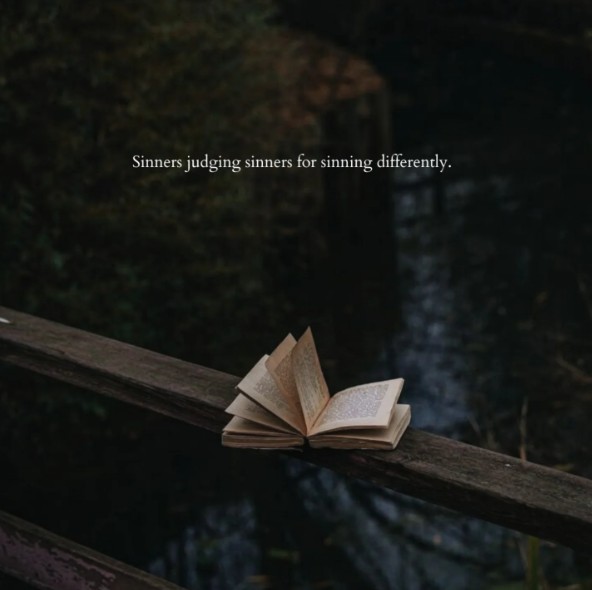
We live in an age where nearly everyone believes they are fundamentally a good person.
Not perfect, maybe Not saintly but “good enough.”
We reassure ourselves with comforting justifications:
- “I don’t harm anyone intentionally.”
- “I lost my patience because I was tired,”
- “My mistakes are small… everyone makes them.”
We wrap ourselves in self-protection, convincing the mind that we are on the right side of morality simply because we don’t commit dramatic, headline-worthy sins.
But here is the uncomfortable reality: Today, almost everyone has become a selective sinner.
This word alone sinner makes people stiffen, defensive, offended because in modern times, we have rebranded wrongdoing. We no longer call it wrong.
We call it:
- “Human nature,”
- “Situational,”
- “My personality,”
- “Just being real,”
- “Practical,”
- or the most convenient excuse of all “Everyone does it.”
But look closely at how society behaves today. Most of us are not striving to be righteous, we are striving to be comfortable. We don’t want to eliminate wrong behavior, we want to choose the type of wrong that:
- Doesn’t make us feel guilty,
- Doesn’t threaten our image,
- Doesn’t cost us anything,
- Still lets us sleep peacefully at night.
We have entered a mindset where goodness is negotiable but reputation is sacred.
Instead of doing what is right, we choose:
- The wrong that is convenient,
- The wrong that benefits us,
- The wrong we can hide or justify,
- The wrong that is socially acceptable,
- The wrong we can explain away with a well-crafted excuse.
Morality has become a personal buffet. We pick the virtues that suit our lifestyle and set aside the ones that demand effort, accountability or self-reflection.
People says: “I am respectful,” but their respect is selective, available only for those who are rich and wealthy and the one who are actually help them are just slaves.
People says: “I am not a liar,” but their honesty evaporates the moment truth becomes inconvenient.
People says: “I don’t harm anyone,” while their sarcasm, silence, jealousy or passive aggression quietly wounds others in ways they never admit.
We want the world to treat us with generosity but we treat others by calculation. We choose the version of goodness that requires the least sacrifice and the version of sin that gives the most return.
This is why the word “sinner” triggers resistance: Not because it’s harsh but because deep down, we know it touches something we avoid seeing. Not the dramatic, visible sins.
But the subtle ones:
- The pride hidden under calmness,
- The cruelty wrapped in “just giving feedback,”
- The jealousy tucked into a joke,
- The disrespect masked by “just being honest,”
- The selfishness disguised as prioritizing ourselves.
We may not commit the sins found in scriptures but we commit the ones that silently eat character from within.
And in today’s world **We are not trying to be flawless, We are trying to be comfortable in our flaws.**
We are less concerned with living rightly and more concerned with customizing our wrongdoing in a way that looks harmless, sounds reasonable and preserves our self-image.
That is selective sin. And it is becoming the cultural norm.
The Age of “Convenient Purity”
Today morality has stopped being a disciplined value system and has instead become a buffet, we no longer adopt principles. We shop for them.
We choose values not based on what is right but based on:
- What makes us look good,
- What aligns with our convenience,
- What fits our lifestyle without challenging it.
We want the prestige of being moral without the discomfort of becoming moral.
People today love the appearance of spirituality not because they truly want to find peace within and make our environment/society a better place but to use Spirituality as A Brand too improve their image.
They proudly announce:
- “I have read the Gita.”
- “I meditate every day.”
- “I live by karma.”
- “I believe in the universe.”
These statements sound mature, evolved, enlightened.
But the moment real spirituality demands:
- Restraint,
- Discipline,
- Humility,
- Self-correction,
- Letting go of ego,
- Being kind even when angry,
- Doing the right thing even when it hurts…
Suddenly, everything becomes silent.
The scriptures are no longer quoted.
The philosophy is no longer convenient.
And morality is paused until further notice.
Now a days a strange trend has emerged: People do not follow scripture to transform themselves, they use scripture to validate themselves. They quote wisdom not to evolve but to:
- Win arguments
- Shame someone
- Justify their actions
- Prove their intellectual superiority
- Show off spiritual literacy
Many don’t use the Gita as guidance, they use it as ammunition.
It is no longer: “How should I improve myself?”
It has become: “How can this line be used to prove I was right?”
And funniest part is they do not even have knowledge of the books they are referring to or the gods they are adoring.
The Bhagavad Gita, Quran, Bible, Guru Granth Sahib – every sacred text has one common expectation: Transformation through practice. But today, half knowledge has replaced practice. We hold quotes in our social media accounts but never let them enter our behavior.
We highlight verses about strength, destiny, divine support or cosmic rewards but conveniently skip the verses that demand:
- Controlling anger
- Losing the ego
- Serving others
- Renouncing pride
- Doing your duty without expectation
- Accepting responsibility for your own actions
We want the glory of the teaching without the burden of the practice.
We memorize verses but ignore the mirror they hold up to us.
This is what selective spiritual morality looks like:
- We love the part of karma that promises reward but ignore the part that demands righteous action.
- We love the part of dharma that blesses us but skip the part that asks us to carry duty with dignity.
- We love the shlokas about divine protection but ignore the ones about discipline, service and humility.
We pick only the verses that feel good to the ego and reject the ones that challenge it.
We are not following wisdom.
We are filtering wisdom.
People now say: “I am spiritual,” but cannot control their temper.
“I follow the Gita,” but insult people publicly.
“I believe in karma,” but cheat, gossip or manipulate without hesitation.
The outer language has evolved.
The inner character has not.
Spirituality has become something we talk, not something we live.
If we truly followed these teachings:
- Our words would be softer.
- Our hearts would be cleaner.
- Our judgments would decrease.
- Our patience would grow.
- Our ego would shrink.
- Our compassion would increase.
But many of us want the appearance of spiritual elevation without the inner revolution it requires.
We Don’t Want Guidance, We Want Validation. That is the tragedy of modern morality, we don’t seek wisdom to become better, we seek wisdom that makes us feel better about staying the same.
We aren’t learning to elevate behavior, we are learning to decorate behavior.
Instead of changing ourselves, we have learned to defend ourselves.
And that is why, today we are not followers of scripture, we are editors of scripture highlighting what suits us and erasing what doesn’t.
We are not living morality.
We are curating it.
Not for our soul but for our comfort.
And the funniest part is we no longer using the teachings to help society, people or nature. We are using it to manipulate them.
Most people will never shout, abuse or insult openly.
No.
We do something more subtle, more polished:
- Passive-aggressive comments
- Sarcasm dressed as humor
- “Good advice” with hidden superiority
- Jokes that attack someone’s identity, finances, family, body or status
- Statements meant to make the speaker look bigger and the other smaller
Just because we don’t raise our voice doesn’t mean we don’t harm.
Sometimes the most cutting wounds are delivered politely.
Modern Sin Has New Packaging
Today’s sins are not the old ones like violence, theft, cruelty.
No.
Today’s sins look like:
- Manipulation disguised as maturity
- Judgment wrapped in “I’m just saying”
- Using spiritual quotes as weapons
- Smiling while silently competing
- Compliments with bitterness underneath
- Offering support until the person stops being useful
We have modernized sin without eliminating it.
Selective Morality Is Hypocrisy
People now judge others for the same sins they commit.
- The person who gossips judges others for gossiping.
- The person insecure about their own body comments on someone else’s appearance.
- The person unhappy with their finances mocks someone else’s struggle.
- The person who never supports anyone complains about lack of support.
We fail to see ourselves clearly yet expect everyone else to be perfectly clean.
That is selective morality.
That is selective sin.
People are kind as long as:
- The person is useful
- The conversation benefits them
- The relationship is convenient
- The situation is in their favor
The moment helping someone requires sacrifice, time, empathy or effort:
- They disappear
- They become “busy”
- They avoid
- They suddenly can’t see the suffering in front of them
We take from the world without giving back but karma is not confused.
We may be selective, the universe is not.
And we are not like this Not because we are evil.
Because reality has become uncomfortable.
Being good takes work.
- It takes honesty to look at our flaws.
- It takes courage to apologize first.
- It takes maturity to not mock others.
- It takes strength to help when it doesn’t benefit us.
- It takes discipline to walk the path we preach.
It’s easier to pretend we are good than to truly become good.
Most people don’t realize: You can be smiling, calm, respectful in tone and still be cruel in intention.
You can say something “nice” and still mean it to hurt.
You can share a “spiritual quote” and still use it as a tool of ego.
Morality isn’t in what we show the world.
It is in what we carry inside.
True Character Appears When, It’s easy to appear good when goodness is rewarded.
Anyone can be honest when honesty brings applause.
Anyone can be kind when the world is watching and admiration follows.
But the real examination of character happens in quieter moments, moments where the world has nothing to offer you in return.
• When There’s Nothing to Gain
Doing the right thing when it benefits you is called strategy.
Doing the right thing when it benefits no one, not even you is called character.
Will you:
- Support someone who cannot help you back?
- Keep promises that cost you?
- Give without expecting gratitude?
When there is no reward attached, intention becomes pure.
This is where true goodness begins.
• When No One Is Watching
Morality shown in public may be reputation.
Morality practiced in private is integrity.
It is easy to be ethical when people are observing your behavior.
But who are you when:
- The door is closed?
- The camera is off?
- The audience has left?
Your behavior in silence is the most honest reflection of your soul.
• When Applause Is Absent
Many people act kind because kindness brings praise.
Many stay disciplined because discipline brings recognition.
But what happens when:
- The achievement goes unnoticed?
- The effort is unseen?
- The good deed is ignored?
If you still walk the same moral path, your goodness is real not performed.
• When Praise Stops Coming: Some people grow bitter or resentful when they stop receiving appreciation. They believe praise was the fuel keeping them going. But for a spiritually evolved person, praise may be sweet but it is never the reason. They do what is right because it is right. They don’t change direction just because the world stopped clapping.
• When Morality Becomes Inconvenient – This is the hardest test of all. True goodness is not measured in peaceful times but during friction, pressure and discomfort.
- When the truth could cost your job
- When kindness demands sacrifice
- When forgiveness requires swallowing pride
- When loyalty hurts
- When doing what is right puts you at a disadvantage
Morality practiced in convenience is decoration.
Morality practiced in discomfort is transformation.
Goodness is not tested in temples, on social media or in public speeches but in the inner choices only you will ever know. The world may never witness your most moral moment.
No applause will come.
No spotlight will shine.
No story will be written.
But in that silent moment, your soul will know.
And that is the test of character, when you choose what is right even when the world gives you every reason not to.
That is where real goodness lives, that is where spirituality becomes practice and righteousness becomes identity.
Being good is not about:
- Talking softly
- Posting spiritual captions
- Saying “I believe in karma”
- Quoting scriptures
- Avoiding visible sins
Being good is about:
- Living your values
- Accepting your flaws
- Not defending your wrongs
- Not humiliating others
- Not taking silent revenge
- Not being a saint on Sundays and a demon on Mondays
Goodness is not an image, It’s a lifestyle.
Before Pointing A Finger, Look In The Mirror
If we don’t like:
- Gossip
- Judgment
- Betrayal
- Cruel jokes
- Dishonesty
- Bullying
- Ego
Then ask yourself “Do I also do the same?” because the person who cannot correct themselves has no right to correct the world.
Forget philosophy, religion, scriptures for a moment. Let’s return to something simpler:
- Be kind even when nobody sees.
- Help when you can’t benefit.
- Keep confidence even when nobody trusts you.
- Don’t degrade others to lift yourself.
- Speak with compassion, not superiority.
- Live the values you expect from others.
If we start doing just these, the world would heal quietly.
We Don’t Need To Be Perfect, We only need to be:
- Conscious of our faults
- Willing to improve
- Honest with ourselves
- Accountable for our intentions
- Humble in our victories
- Gentle in our judgments
The first step to being good is admitting that we still have work to do.
So before we call someone else a sinner, we must ask: “Which sins have I become comfortable with?”
Because the world doesn’t need selective goodness, It needs sincere goodness.
Not perfection, just truth.
Not holiness, just humanity.
Not convenient morality but consistent morality,
even when no one is watching.
Because in the end, the loudest prayer we offer is the way we live, the way we speak and the way we treat others not the way we pretend.

 Story and Beyond with Pratiksha
Leave a comment