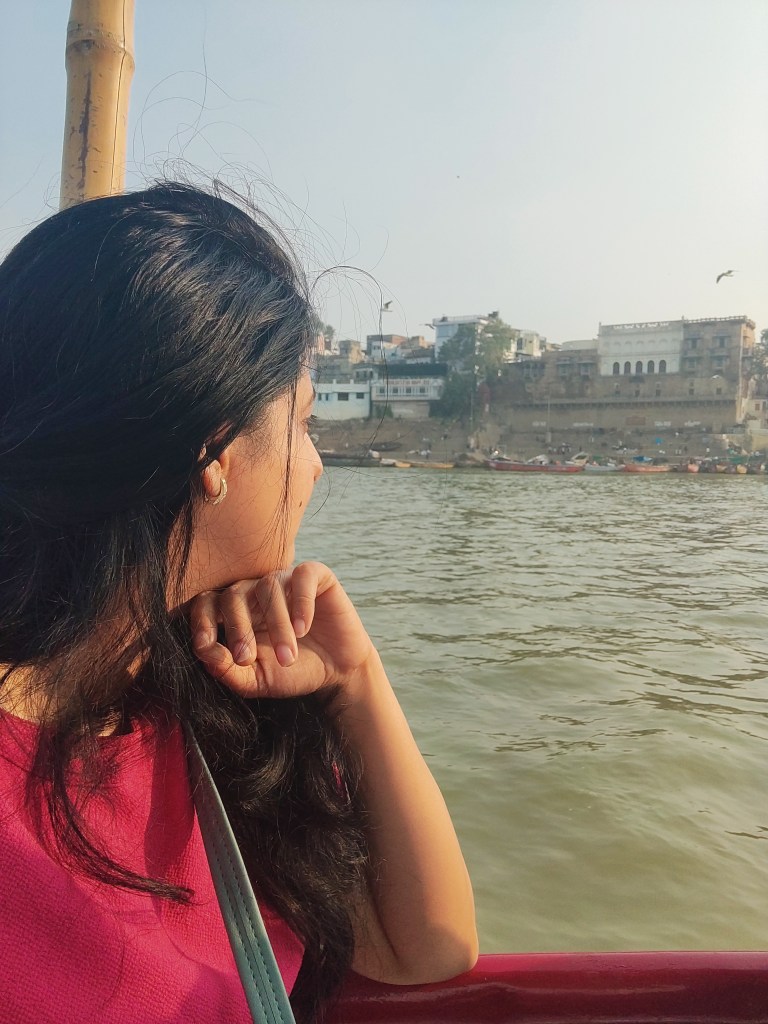
I know many of you notice the recurring whispers of Banaras in my blogs and might wonder – what exactly is her connection with that city?
Well, maybe it’s time I take you there, not just through words but through memories. Because Banaras isn’t just a place I write about – it’s the city I was born in, the one that shaped my rhythm of thought, my faith and perhaps even my sense of belonging.
Today, I feel a gentle responsibility to walk you through its galis – those narrow, ancient veins of the oldest living city in the world, Kashi.
Yes, that Kashi where every sunrise feels like a hymn rising from the Ganga, where the breeze carries the fragrance of burnt camphor & marigolds and where silence itself hums the name of Mahadev.
It’s a city where faith isn’t something you perform, it’s something that breathes through you.
Where time doesn’t move forward, it circles back, again and again, reminding you that life and death, joy and loss are all part of the same eternal rhythm.
Banaras teaches you how to let go but also how to hold on to love, to devotion, to stories that refuse to fade.
Banaras doesn’t rush.
It moves with rhythm, a divine tempo that flows in sync with the Ganga’s calm yet powerful current.
At dawn, when the first light kisses the river, the ghats awaken like verses of an ancient hymn. The sound of conches fills the air, temple bells echo across the water and diyas drift like little dreams, each carrying a prayer, a memory, a whisper of hope. The fragrance of sandalwood, marigolds and incense dances through the air wrapping the city in a sacred warmth.
I still remember walking hand in hand with my mother through those narrow lanes barefoot, yet more grounded than ever.
The galis of Banaras are a world of their own where chaos and calm coexist effortlessly.
A priest hurries past with a thali of flowers and kumkum, an old man savors his morning chai by a cracked stone wall and somewhere, a faint bhajan hums through a transistor lost in time.
It’s strange how Banaras can be loud and silent at the same time, its heartbeat steady, yet its soul infinite.
And in that paradox lies its beauty.
There’s a saying every Banarasi grows up hearing:
“Mahadev ne Varanasi ko apne Trishul pe utha rakha hai.” It means Lord Shiva himself holds the city upon his trident.
And once you walk its streets, you’ll believe it.
Because Banaras feels suspended, not just between heaven and earth but between illusion and truth.
In other cities, my mind often races, too many thoughts, too many plans, too much noise. But in Banaras, everything stills.
The city doesn’t ask you to chase meaning, it hands it to you in the simplest ways. In the reflection of the sunrise on the Ganga. In the quiet wisdom of a pandit’s smile. In the unspoken peace of watching an aarti flame merge with the night sky.
Banaras doesn’t feed you myths, it unveils truth.
It doesn’t distract; it grounds.
It doesn’t promise you clarity; it gives it.
Because once you surrender to its rhythm, Banaras doesn’t just show you the world – it shows you yourself.
Mahadev and the Eternal Soul of Kashi 🔱
The story of Kashi and Mahadev begins long before the city’s lanes were paved, before the ghats met the Ganga and long before any mortal could call it home. This land vibrant with cosmic energy even in its untouched form was chosen by Lord Shiva himself who declared it sacred above all others. To protect its sanctity, he placed the city upon his Trident (Trishul) not merely as a symbol but as a divine assurance that Kashi would never fall to floods, fire, war or corruption.
This story starts long ago, after their celestial marriage atop Mount Kailash, Goddess Parvati and Lord Shiva sought a place in the mortal world to settle – a “siddha kshetra”, a land suffused with spiritual accomplishment and divine energy. They wished for a city where devotion, learning and the rhythm of life would harmonize with the divine presence they carried within them.
Traveling across the earth, they surveyed countless lands, snow-capped mountains, vast plains, sacred forests in search of the perfect abode. Then, their eyes fell upon a city unlike any other – Kashi. Exquisitely built, alive with devotion, music and the sacred flow of the Ganga, the city radiated a spiritual power that resonated deeply with Shiva. Here, the human and divine could coexist in perfect balance.
Shiva was so moved by Kashi that he decided to make it his permanent abode, a promise that would shape the destiny of the city for all time. The land where he chose to reside became Avimukta Kshetra – “the never-forsaken place,” a city he would never abandon, no matter the trials the world might bring.
However, circumstances required Shiva and Parvati to temporarily leave the city. Yet their love and protection for Kashi could never waver. Before departing, they entrusted the city to the wisdom of the learned pandits and sages and Shiva’s placement of Kashi upon his Trishul ensured that the city would withstand the test of time, calamities, invasions and the darkness of Kaliyug standing forever as a beacon of devotion, learning and cosmic balance.
From that day onward, Kashi became inseparable from Shiva and Parvati, not just a city but a living, breathing extension of their divine presence. Every ghat, every lane, every temple became infused with their energy drawing devotees seeking liberation, wisdom and the embrace of the divine.
Even today, walking through Kashi, one can feel the resonance of that promise. The city pulses with the rhythm of Shiva’s Trishul while Parvati’s nurturing energy quietly flows through every ritual, every chant and every act of devotion. This sacred union of the divine with the mortal city gives Kashi its immeasurable power, eternal charm and unshakable status as the spiritual heart of India.
Kashi is said to exist in Mahadev’s heart. The earth of this city pulses with his presence and every stone, every riverbank and every alley carries his energy. To ensure its sanctity, he entrusted the fierce Kalbhairav with the city’s guardianship, roaming its lanes, watching over every ritual, every home, every soul. It is Kalbhairav who keeps the city resilient against chaos, injustice and time itself.
And when the world faces the darkness of Ghor Kaliyug, Kashi will stand tall – untouched, unwavering because how could Mahadev let his beloved city crumble? Not the city. Not the people who call it home. Not the countless generations who live and die under its skies.
As children growing up in Kashi, we all dreamt of making it big of skyscrapers, bustling metros and fame in far-off cities. I was no different. I wanted the world, its glamour, its opportunities.
Yet, no matter how far I traveled, no city, no crowd, no skyline could ever replicate the peace that Kashi breathes into your soul. The chaos of its streets, the constant rhythm of life, the sacredness woven into ordinary moments – it always called me back.
Returning there, it always feels like Mahadev himself places his hand on my head silently blessing me, reminding me of roots, of purpose, of protection. The city doesn’t just exist; it embraces, guides and steadies you.
Because Kashi is not just a city. It is the embodiment of Mahadev’s love, his protection and his presence in the world – eternal, unshakable and infinitely alive.
The Temples of Varanasi(Where Myth Meets Reality)
Varanasi isn’t just a city of ghats, silk and street food, it’s a city built around devotion where temples are the heartbeat of life and every stone seems to hum the name of the divine. Walking its lanes, you realize that faith here isn’t a ritual; it’s woven into the very fabric of daily existence.
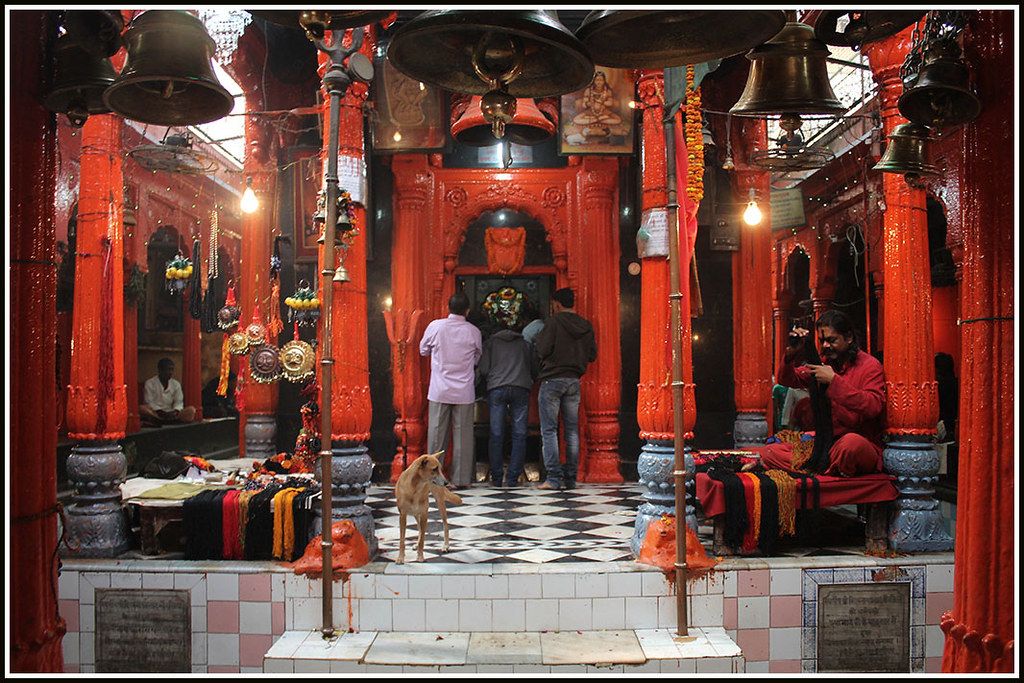
Kalbhairav Mandir(The Guardian of the City) : No discussion of Varanasi’s temples is complete without Kalbhairav Mandir. Kalbhairav, the fierce form of Shiva is believed to protect the city from chaos and injustice. This deity is deeply intertwined with local lore from safeguarding the ghats to watching over every ritual performed in Kashi. It’s said that Kalbhairav roams the city’s lanes ensuring that Mahadev’s presence remains strong. Pilgrims often visit to seek courage, protection and clarity in moments of fear or confusion and take permission to go further for taking blessings from Kashi Vihswanath.
Kashi Vishwanath Temple(The Heart of Kashi) 🔱: At the very heart of Varanasi, where the city’s soul seems to pulse strongest, stands the Kashi Vishwanath Temple, a timeless sanctuary dedicated to Lord Shiva. This is not just a temple; it is the axis of faith, devotion and spiritual energy in Kashi, a place where the divine seems to breathe through every stone and echo through every prayer.
Legends say that Shiva himself chose Kashi as the city where his divine Shivling would rest, a symbol of cosmic power, knowledge and liberation. It is said that the very land hums with his presence that every stone, every pathway and every whisper of the Ganga reflects the energy of Mahadev.
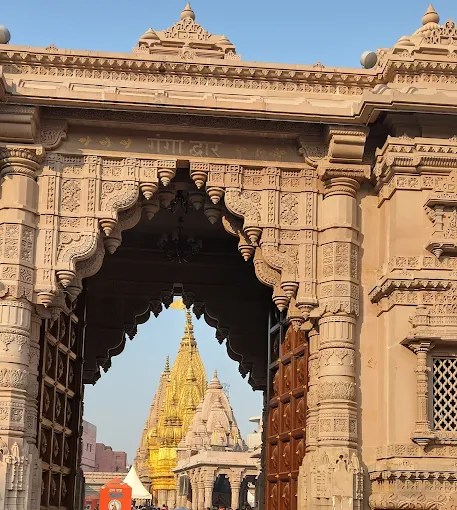
The original lingam however, did not remain unchallenged. Over centuries, invaders attempted to destroy or appropriate it, forcing the sacred icon to be hidden, its exact location known only to the priests who safeguarded it. Time and history may have tested it but the devotion of generations of Banarasis ensured that the temple would rise again and again. Each rebuilding, renovation and restoration only added to its magnetism, its aura of invincibility making it a beacon of hope and faith for anyone who enters its precincts.
Today, the temple stands tall and radiant, its golden spire glittering under the sun drawing pilgrims from all corners of the world. Barefoot devotees tread its marble floors carrying offerings of flowers, bilva leaves and incense. Some hum bhajans under their breath, others remain silent letting the energy of the place envelop them. There is a force here that is beyond explanation, beyond logic – a quiet pull that tugs at your heart and stirs a sense of reverence unlike anywhere else.
Nearby lies the Gyanvapi area, a region steeped in centuries of history and spirituality. At its heart is the Gyanvapi well believed to be directly linked to the original Shivling. Legend has it that the waters of this well hold the wisdom of ages, a silent reservoir of knowledge, devotion and divine energy. Walking along the Gyanvapi precincts, you feel as though the past and present converge : a tangible bridge between myth and reality, legend and lived experience. Every stone, every archway and every scent of incense reminds you that in Kashi, the divine is never distant, it’s woven into the very fabric of the city.
Visiting Kashi Vishwanath Temple is not merely about ritual or sightseeing; it is about being touched by centuries of devotion, feeling the pulse of faith and standing in the presence of something eternal, something that whispers to you in the silence between chants and the flicker of aarti lamps. Here, history, legend and spiritual energy do not just coexist – they merge into an experience that transforms you, humbles you and anchors you in the heart of Kashi.
Vishalakshi Temple(The Shaktipeeth of Kashi) : Among the sacred sites of Varanasi, Vishalakshi Temple stands as a powerful beacon of divine feminine energy. Dedicated to Goddess Vishalakshi, one of the revered 51 Shaktipeeths, this sacred shrine is believed to be the place where Goddess Sati’s earrings (kundal) fell to earth. Since that divine moment, the temple has been honored as an eternal abode of Shakti, a place where the power of the Goddess radiates through every stone symbolizing wisdom, compassion and cosmic strength that continues to watch over Kashi. In Varanasi, where Shiva is the heartbeat of the city, Vishalakshi represents the vital pulse of the divine feminine, a balance that gives life, strength and protection to the land.
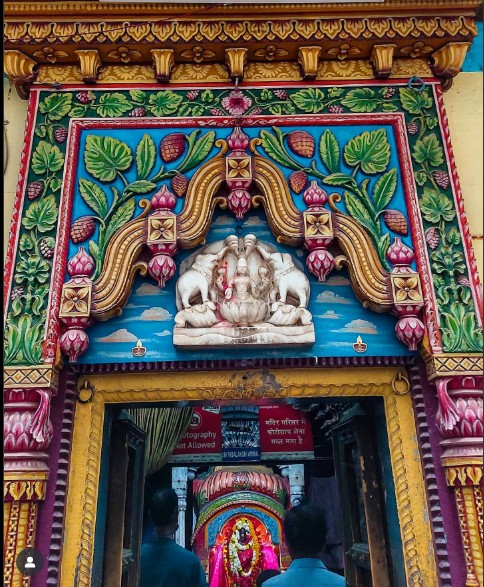
The temple itself sits gracefully on a slightly elevated spot, its simple yet sacred architecture concealing centuries of devotion. Unlike the bustling grandeur of Kashi Vishwanath, Vishalakshi Temple exudes a quiet intensity. As you step inside, the air feels charged with energy, incense curls lazily around the sanctum, bells chime intermittently and the soft chants of devotees echo like whispers of ancient wisdom.
Legends say that Rani Ahilyabai Holkar, the revered queen and patron of temples across India once renovated the temple preserving its sanctity while making it accessible to devotees for generations to come. Every stone here resonates with the faith of countless pilgrims who have come seeking blessings for courage, clarity and protection.
The rituals are simple yet profoundly moving. Devotees offer red flowers, kumkum and fruits while reciting mantras that invoke Shakti in her most compassionate yet powerful form. The goddess is believed to grant strength to the weak, clarity to the confused and courage to those burdened by fear or misfortune. In a city where life and death are observed so closely, Vishalakshi Temple reminds you that Shakti is the invisible force that sustains the universe and our own inner balance.
Walking away from the temple, you can feel the residual energy clinging to your being, a subtle awareness that the feminine divine compassionate yet fierce is always present, guiding, protecting and reminding the city and its people of their resilience. In a place like Varanasi where every alley, every ghat, every temple has a story, Vishalakshi Temple stands as a quiet yet potent testimony to the eternal power of Shakti.
Durga Mandir(The Power of Shakti) : The Durga Mandir located in the old city is a bright red temple with towering spires dedicated to Goddess Durga. It’s vibrant throughout the year and the entire city celebrates her divine energy. Locals believe that the goddess protects the city and blesses those who come with sincere devotion.
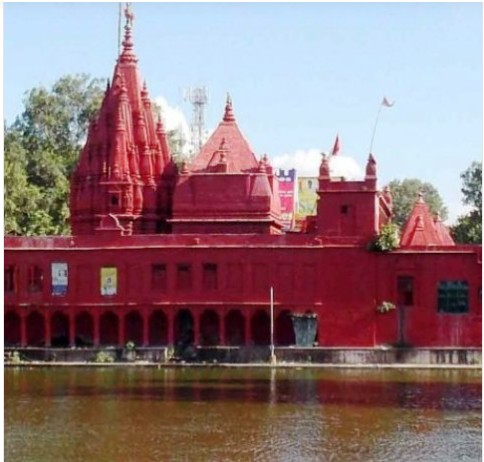
Here every festival, every ritual, every offering is a celebration of life, energy and protection, a testament to the feminine divine that balances the city’s spiritual rhythm.
Ganesh Mandir(The Remover of Obstacles) : Hidden in plain sight just behind the towering Durga Mandir lies a small but significant Ganesh temple. Locals often stop here before entering Durga Mandir following the tradition of seeking Ganesh’s blessings(the remover of obstacles) before worshipping any other deity. This little temple is always bustling with devotees offering laddoos and flowers, its energy quietly powerful.

Sankat Mochan Mandir(The Vanquisher of Troubles) : Dedicated to Lord Hanuman, Sankat Mochan Mandir is more than just a temple : it’s a sanctuary for anyone seeking relief from life’s troubles, big or small. The very name Sankat Mochan means “the remover of obstacles and miseries”, and stepping inside you immediately feel that energy vibrating in the air.
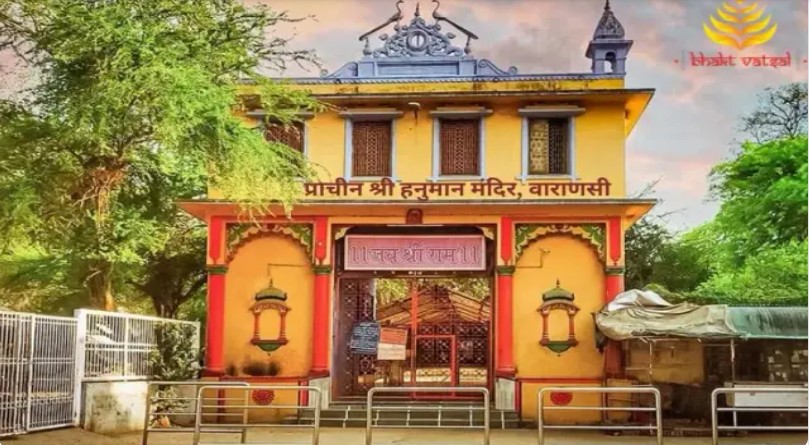
Visiting early in the morning is an experience unlike any other: bhajans echo through the narrow lanes, mingling with the rhythmic clang of temple bells and the soft rustle of offerings. The chants seem to rise and fall with the city itself creating a spiritual symphony that wraps around your soul.
Tulsidas, the revered poet and saint composed many of his immortal verses in the shadow of this temple connecting devotion, poetry and community in the heart of Varanasi.
What’s even more remarkable is the temple’s resilience. Despite the chaos of the outside world including the tragic Varanasi bomb blasts, the inner sanctum remained untouched standing as a testament to divine protection and the faith of generations who have turned to Hanuman here for courage and solace.
Visiting Sankat Mochan is not just about prayers; it’s about experiencing a space where devotion, history and protection intertwine, a place where you can feel both the pulse of the city and the calm of the divine in one breath.
Tulsimanas Mandir(The Poet’s Blessing) : Dedicated to Tulsidas(the poet-saint behind the Ramcharitmanas), Tulsimanas Mandir is a quiet place where the spiritual and literary blend seamlessly. It’s said that Tulsidas composed many hymns and verses that still resonate here, echoing devotion, dharma and love. Visiting it feels like touching history through words, chants and faith.
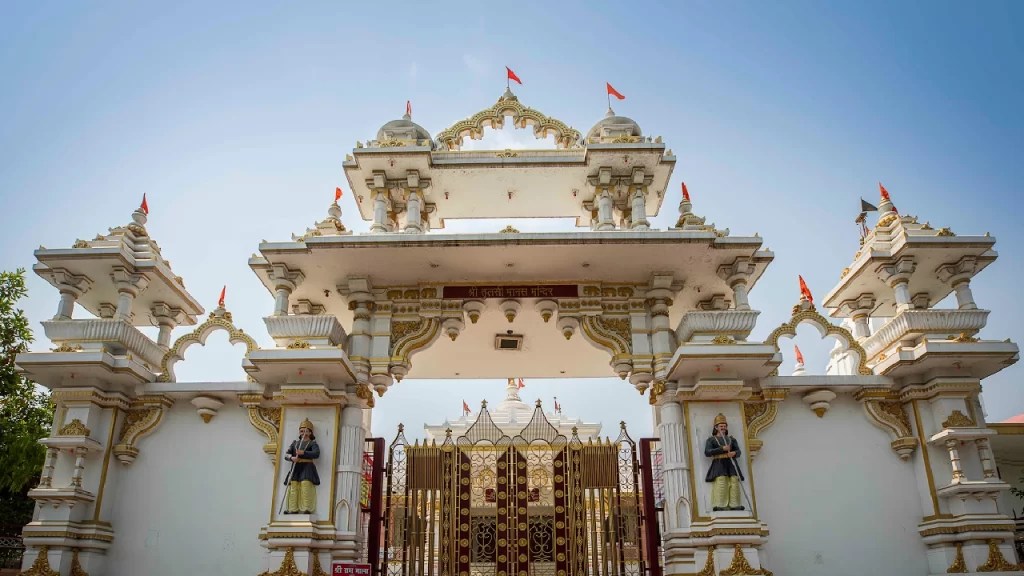
Kedar Temple at Kedar Ghat(A Hidden Gem of Devotion) : Perched along Kedar Ghat, the Kedar Temple is powerful in spiritual presence. Dedicated to Lord Shiva, it offers serene river views and a meditative space for pilgrims. Locals believe that offering prayers here, especially during the early morning aarti brings peace, insight and a direct connection to the divine flow of the Ganga.
It’s fascinating how Kashi integrates the divine hierarchy and flow of worship into its lanes, Ganesh guiding devotees to Durga, Mahadev watching over the city from Kashi Vishwanath and Kalbhairav protecting every soul that walks the ancient streets.
In Varanasi, temples aren’t isolated monuments, they’re interwoven with daily life. Every morning, the city awakens with mantras; every evening, the ghats and temples echo with chants, aarti and prayers.
Walking from Kashi Vishwanath to Sankat Mochan, Durga Mandir or Kedar Ghat, you feel the city’s heartbeat in every step. You smell incense, see diyas drifting on water, hear bells ringing and sense an energy that is both grounding and transcendent.
Each temple tells a story of devotion, protection, artistry and human connection with the divine. Together, they create the spiritual rhythm that defines Kashi, a city where the divine doesn’t just live in temples – it lives in every corner, every lane, every heart.
Life, Death and the Eternal Flow of Banaras
In Banaras, even death is woven seamlessly into the rhythm of life. Here, the Manikarnika and Harishchandra Ghat burns day and night, its flames a constant, unflinching reminder of impermanence. To outsiders, the ghat may appear somber, even unsettling. But in the language of Banaras, these flames speak not of sorrow but of liberation, acceptance and transcendence.
There is no fear here, only the profound understanding that every life is a river : flowing, changing and eventually returning to its source. The city teaches a truth that is easy to hear but hard to witness: to live fully, you must make peace with endings. Every beginning carries the seed of an end and every end holds the silent promise of continuity in another form. Standing by the Ganga at twilight watching the diyas float gently across the river, you realize that Banaras is less about life or death and more about what flows between them – the stories, the love, the devotion, the quiet moments that transcend time.
Yet understanding this intellectually is one thing. Experiencing it, living it, is another. I know this because I have stood at the ghat watching the flames claim someone I adored. In 2020, I lost my father – the man whose presence was the anchor of my childhood, whose stories and laughter echoed through every corner of Kashi. My father had always been deeply tied to the city, leaving it even temporarily felt like a sin in his eyes. Every journey outside, every function far from Varanasi left him longing. telling tales of the streets, the ghats and the connections that were his lifeblood.
He had been battling kidney failure since 2019 undergoing dialysis but when the doctors told him his kidneys were 92% damaged, I saw something I had never seen before – the man of unyielding will, strength and determination crushed, vulnerable and human.
The fire of life within him flickered – uncertain, fragile yet full of quiet strength. We clung to hope believing that treatment might still heal him. But by December 2020, his body began to surrender unable to respond anymore. And just like that… he was gone.
I never imagined how suddenly someone could leave. One moment he was heading for dialysis and the next, he was calling us to sit beside him tears glistening in his eyes as he said how happy he felt seeing all his family together. A few days later, he slipped away.
The fire of life within him flickered – uncertain, fragile yet full of quiet strength. We held onto hope believing that somehow the treatment would heal him. But by December 2020, his body began to surrender unable to respond anymore. And just like that… he was gone.
I never imagined how suddenly someone could leave. One moment he was preparing to go for dialysis and the next, he was calling us to sit beside him tears glistening in his eyes as he said how happy he felt seeing all his family together. A few days later, he slipped away.

The man who had always been so fiercely independent who took care of himself even during illness, who sometimes went for dialysis all by himself, had come to this. Watching him lose that strength was unbearable. I still remember my conversation with my mother before that telling her she wouldn’t be able to manage alone, that we should move with him to Noida.
But that thought of leaving Banaras, of becoming dependent on us troubled him more than his illness ever did. He couldn’t bear it. I still hear his words echoing in my mind: “Batao, ab main apne shareer ka khayal bhi nahi rakh sakta”
That broke something deep within us.
Banaras wasn’t just his home; it was his heartbeat. The city lived in his mind, in his words, in the rhythm of his prayers. How could anyone take that away from him?
And perhaps that’s how it was destined to be, he lived in Banaras with the same independence that defined him all his life, that he engraved in us and he left from Banaras, the only place his soul ever truly belonged.
The ghat where he was cremated became more than a ritualistic site, it became a sacred imprint on my memory and soul. Every time I pass Harishchandra Ghat now, I see not just the flowing river or the eternal flames but the spot where I said goodbye where life and death merged into a moment that was both unbearable and illuminating. That ghat, that fire, the Ganga itself – they carry an emotion so raw, so unwavering that it leaves you stripped of pretense and fully present with the truth of existence.
Banaras teaches you through moments like these that grief is not separate from life, that love, loss, devotion and surrender are threads in the same sacred fabric. Watching the flames at Manikarnika/Harishchandra is easy in theory but when the life burning before you belongs to your own father, it etches into your soul an irreplaceable understanding of impermanence, love and the quiet courage of letting go.
Even now, when I walk past the ghats, the city whispers to me: “This is life, This is death and This is everything in between.” And in that whisper, I feel him – not gone, not distant but part of the eternal rhythm of Kashi flowing endlessly with the Ganga.
The Spiritual Pulse of Banaras 🌊
In Banaras, mornings don’t just begin, they wake with a chant, a mantra, a breath of devotion. The air carries the resonance of sacred hymns, the aroma of incense and the subtle warmth of diyas flickering at the ghats. Slowly, the city stirs and the Ganga mirrors the first light shimmering with prayers that have floated here for centuries. It’s a rhythm that doesn’t rush; it pulses steadily like a heartbeat you can feel under your feet as you walk along the stone steps.
Evenings are no less sacred. The Ganga Aarti transforms the river into a living altar. Flames dance on the water reflecting in the eyes of those gathered at the ghats. Conches, chants and bells mingle with the soft lapping of the river creating a symphony that feels both eternal and intimate. You stand there watching the flames drift downstream and for a moment, the world outside the ghats with all its chaos, deadlines and distractions ceases to exist.
Here, time doesn’t move in a straight line. It loops, spirals and folds gently back upon itself. Past and present coalesce: the footsteps of pilgrims from centuries ago echo alongside your own, the stories of saints and sages ripple in the river, and yet, you are entirely in the moment.
Banaras doesn’t change you overnight. It doesn’t bombard you with lessons or force revelations. Instead, it reveals you, layer by layer, memory by memory. It teaches patience, humility and presence of wisdom that seeps quietly into your soul while you watch the city awaken or witness the aarti unfold.
So, if you ever find yourself there, don’t rush to “see” it.
Don’t tick off the ghats or cross the markets in a hurry.
Instead, walk slowly, listen carefully and feel deeply. Let the city unfold itself to you like a secret whispered over centuries.
Because Banaras isn’t meant to be visited, it’s meant to be felt.
Banaras is my beginning and my grounding.
It’s the cradle of my faith, the muse behind my words and the rhythm that guides my thoughts. Every memory of its ghats, every taste of its food, every touch of its silk and every echo of its chants is stitched into the fabric of who I am.
And if you ever wonder why Banaras keeps appearing in my blogs, it’s simple:
Because no matter where life takes me, no matter the cities I see or the experiences I gather, Kashi walks with me, quietly, endlessly like a heartbeat that never fades. 💛
I’ve wandered far from my city, seen the snow-capped mountains of Himachal, felt the sun-drenched beaches of Goa and been swept up in the neon chaos of Mumbai. I’ve stood in crowded streets, taken ferries across glistening waters and watched sunsets in places both familiar and foreign.
But no matter where I go, every time I close my eyes, I find myself back there on those ghats watching the first rays of the sun dance on the Ganga, feeling the cool morning mist kiss my skin, hearing the distant chant of mantras mingling with the river’s flow.
Banaras isn’t just where I was born.
It’s where my soul learned to breathe. Where patience became a rhythm and faith became a way of life. The city shaped the way I perceive the world, the calm I carry amid chaos, the quiet observance in every human story and the lens through which my words find meaning.
It’s why Banaras threads its way into everything I write, sometimes as a memory, sometimes as a metaphor, always as a heartbeat beneath the surface.
How do you separate yourself from a place that built you? A place that whispered its lessons into your being long before you realized they were yours to keep? Every visit feels like a reunion, like meeting an old friend who has seen all your versions – the timid, the bold, the lost, the certain and still embraces you exactly as you are.
If you’ve ever been to Banaras, you’ll know it’s not just a destination, it’s an experience that lingers that wraps itself around your senses and refuses to let go. The taste of street food, the shimmer of silk, the smell of incense and the river, the echo of conches at sunrise – it stays in your mind, in your heart, in your breathing.
For me, writing about Kashi is my way of staying tethered to those roots. It’s a love letter to the city that taught me to trust my faith instead of fearing it, to find stillness amidst chaos and to embrace the art of storytelling. Every word, every memory I share is an offering to the river, to the streets, to the people who carry Kashi in their hearts as I do in mine.
I’d love to hear your Banaras stories too, the small moments, the overwhelming emotions or even the first time you stood by the Ganga and felt something shift inside you. Share them in the comments or send me a message because every story from Kashi adds one more diya to this eternal flame 🌼
I know this blog has turned deeply emotional after all, I’ve witnessed birth, growth and liberation in this very city. But the story doesn’t end here. It will continue not just with tales of life and moksha but with everything that flows in between : the Ganga Aarti’s glow, peaceful boat rides, Subah-e-Banaras mornings, the flavors of its food and the charm of Banarasi silk. So stay tuned as the journey through Kashi has only just begun.


 Story and Beyond with Pratiksha
Leave a comment